← 2024 Paper 1

UPSC 2024 Maths Optional Paper 1 Q8b — Step-by-Step Solution

15 marks · Section B

Gauss divergence theorem · Vector Analysis · asked 10× in 14 yrs · Read the full method →

Question

Using Gauss’s divergence theorem, evaluate

∬S(y2i^+xz3j^+(z−1)2k^)⋅n^ dS\iint_S (y^2\hat i+xz^3\hat j+(z-1)^2\hat k)\cdot\hat n\,dS

over the region bounded by the cylinder x2+y2=16x^2+y^2=16 and the planes z=1z=1 and z=5z=5.

Technique

Compute ∇⋅F⃗\nabla\cdot\vec F (only the third component contributes); switch to cylindrical coordinates; the integral separates by Fubini.

Solution
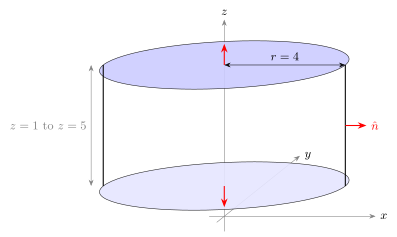
The closed region for the divergence theorem: the solid cylinder x^2+y^2\le16 (radius r=4) between the planes z=1 and z=5, with outward unit normal \hat n on the curved side, the top disk, and the bottom disk. Converting the surface flux to the volume integral of \nabla\cdot\vec F over this region, in cylindrical coordinates, is the whole method.

Step 1 — Divergence.

F⃗=(y2, xz3, (z−1)2),∇⋅F⃗=0+0+2(z−1)=2(z−1).\vec F=(y^2,\,xz^3,\,(z-1)^2),\qquad\nabla\cdot\vec F=0+0+2(z-1)=2(z-1).

Step 2 — Volume integral (divergence theorem).

∬SF⃗⋅n^ dS=∭V2(z−1) dV.\iint_S\vec F\cdot\hat n\,dS=\iiint_V 2(z-1)\,dV.

Volume VV: cylinder r≤4r\le 4, 1≤z≤51\le z\le 5. In cylindrical coordinates dV=r dr dθ dzdV=r\,dr\,d\theta\,dz.

Step 3 — Evaluate.

The integral separates:

∭V2(z−1) dV=∫02πdθ⏟2π⋅∫04r dr⏟8⋅∫152(z−1) dz⏟16.\iiint_V 2(z-1)\,dV=\underbrace{\int_0^{2\pi}d\theta}_{2\pi}\cdot\underbrace{\int_0^4 r\,dr}_{8}\cdot\underbrace{\int_1^5 2(z-1)\,dz}_{16}.

∫152(z−1) dz=[(z−1)2]15=16\int_1^5 2(z-1)\,dz=[(z-1)^2]_1^5=16.

Total=2π⋅8⋅16=256π.\text{Total}=2\pi\cdot 8\cdot 16=256\pi.

Answer

  256π.  \boxed{\;256\pi.\;}
We post more of this — worked solutions, CSAT trap breakdowns, guide chapters — a few times a week on Telegram. Free, no sign-in. Join

This solution is part of the Maths Coverage Map — 14 years, mapped. Get the take-away PDF free.