← 2024 Paper 1

UPSC 2024 Maths Optional Paper 1 Q1e — Step-by-Step Solution

10 marks · Section A

Cylinder · Analytic Geometry · asked 5× in 14 yrs · Read the full method →

Question

Find the equation of the right circular cylinder which passes through the circle x2+y2+z2=9x^2+y^2+z^2=9, x−y+z=3x-y+z=3.

Technique

The cylinder’s axis runs along the plane’s normal through the circle’s centre; a point lies on the cylinder iff its squared perpendicular distance from the axis equals the circle’s radius squared.

Solution

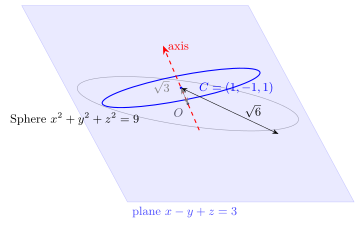
Sphere x^2+y^2+z^2=9 (centre O) cut by the plane x-y+z=3 in a circle of radius \sqrt6 centred at C=(1,-1,1), where OC=\sqrt3. The required right circular cylinder has its axis along the plane's normal (1,-1,1)/\sqrt3 through C, and the same radius \sqrt6 — every point on it lies at perpendicular distance \sqrt6 from that axis.

Step 1 — Locate the circle.

The circle is the intersection of the sphere x2+y2+z2=9x^2+y^2+z^2=9 (centre O=(0,0,0)O=(0,0,0), radius 33) with the plane x−y+z=3x-y+z=3.

Distance from OO to the plane: d=∣0−0+0−3∣/1+1+1=3/3=3d=|0-0+0-3|/\sqrt{1+1+1}=3/\sqrt{3}=\sqrt{3}.

Circle radius: ρ=9−3=6\rho=\sqrt{9-3}=\sqrt{6}.

Centre of circle (foot of perpendicular from OO to the plane): along the unit normal n^=(1,−1,1)/3\hat n=(1,-1,1)/\sqrt{3} at distance 3\sqrt{3}, giving C=3⋅n^=(1,−1,1)C=\sqrt{3}\cdot\hat n=(1,-1,1).

Step 2 — Set up the cylinder condition.

A point P=(x,y,z)P=(x,y,z) lies on the cylinder iff its perpendicular distance from the axis (line through CC along n^\hat n) equals ρ=6\rho=\sqrt{6}. This gives

∣CP⃗∣2−(CP⃗⋅n^∣n^∣)2=6.|\vec{CP}|^2-\left(\frac{\vec{CP}\cdot\hat n}{|\hat n|}\right)^2=6.

Here CP⃗=(x−1,y+1,z−1)\vec{CP}=(x-1,y+1,z-1) and CP⃗⋅n^/∣n^∣=(x−y+z−3)/3\vec{CP}\cdot\hat n/|\hat n|=(x-y+z-3)/\sqrt{3}, so

(x−1)2+(y+1)2+(z−1)2−(x−y+z−3)23=6.(x-1)^2+(y+1)^2+(z-1)^2-\frac{(x-y+z-3)^2}{3}=6.

Step 3 — Expand and simplify.

(x−1)2+(y+1)2+(z−1)2=x2+y2+z2−2x+2y−2z+3.(x-1)^2+(y+1)^2+(z-1)^2=x^2+y^2+z^2-2x+2y-2z+3.

(x−y+z−3)2=(x−y+z)2−6(x−y+z)+9.(x-y+z-3)^2=(x-y+z)^2-6(x-y+z)+9.

Multiplying the equation through by 33:

3(x2+y2+z2−2x+2y−2z+3)−(x−y+z)2+6(x−y+z)−9=18.3(x^2+y^2+z^2-2x+2y-2z+3)-(x-y+z)^2+6(x-y+z)-9=18.

Expanding (x−y+z)2=x2+y2+z2−2xy+2xz−2yz(x-y+z)^2=x^2+y^2+z^2-2xy+2xz-2yz:

3(x2+y2+z2)−6x+6y−6z+9−(x2+y2+z2−2xy+2xz−2yz)+6x−6y+6z−9=18.3(x^2+y^2+z^2)-6x+6y-6z+9-(x^2+y^2+z^2-2xy+2xz-2yz)+6x-6y+6z-9=18. 2(x2+y2+z2)+2xy−2xz+2yz=18.2(x^2+y^2+z^2)+2xy-2xz+2yz=18.

Divide by 22:

Answer

  x2+y2+z2+xy−xz+yz=9.  \boxed{\;x^2+y^2+z^2+xy-xz+yz=9.\;}
We post more of this — worked solutions, CSAT trap breakdowns, guide chapters — a few times a week on Telegram. Free, no sign-in. Join

This solution is part of the Maths Coverage Map — 14 years, mapped. Get the take-away PDF free.