← 2023 Paper 1

UPSC 2023 Maths Optional Paper 1 Q2b — Step-by-Step Solution

15 marks · Section A

Triple Integrals; Cylindrical and Spherical Coordinates · Calculus · Read the full method →

Question

Evaluate the triple integral which gives the volume of the solid enclosed between the two paraboloids Z=5(x2+y2)Z=5(x^2+y^2) and Z=6−7x2−y2Z=6-7x^2-y^2.

Technique

Find intersection projection; integrate the difference of the two surfaces over that region. A linear scaling u=x2, v=yu=x\sqrt 2,\,v=y converts the elliptic region to the unit disk, then polar coordinates.

Solution

Step 1 — Find the curve of intersection.

Set 5(x2+y2)=6−7x2−y25(x^2+y^2)=6-7x^2-y^2:

5x2+5y2=6−7x2−y2⇒12x2+6y2=6⇒2x2+y2=1.5x^2+5y^2=6-7x^2-y^2\Rightarrow 12x^2+6y^2=6\Rightarrow 2x^2+y^2=1.

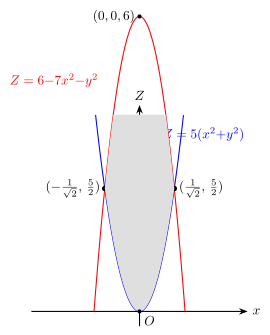
Projection onto xyxy-plane is the ellipse D={(x,y):2x2+y2≤1}D=\{(x,y):2x^2+y^2\le 1\}.

Axial cross-section (y=0) of the solid between the two paraboloids. The lower paraboloid Z=5(x^2+y^2) (blue) opens upward from the vertex O; the upper paraboloid Z=6-7x^2-y^2 (red) opens downward from (0,0,6). They meet on the circle whose cross-section is the pair of points (\pm 1/\sqrt2,\,5/2); the shaded lens is the region whose volume is sought — the upper surface lies above the lower throughout the projection 2x^2+y^2\le 1.

Step 2 — Volume integral.

The upper paraboloid z=6−7x2−y2z=6-7x^2-y^2 is above the lower z=5(x2+y2)z=5(x^2+y^2) on DD. Volume:

V=∬D[(6−7x2−y2)−5(x2+y2)] dA=∬D[6−12x2−6y2] dA.V=\iint_D\bigl[(6-7x^2-y^2)-5(x^2+y^2)\bigr]\,dA=\iint_D[6-12x^2-6y^2]\,dA.

Step 3 — Change of variables to circular coordinates.

Let u=x2, v=yu=x\sqrt 2,\,v=y (so 2x2+y2=u2+v22x^2+y^2=u^2+v^2). Jacobian: ∣∂(x,y)/∂(u,v)∣=1/2|\partial(x,y)/\partial(u,v)|=1/\sqrt 2. Then DD corresponds to u2+v2≤1u^2+v^2\le 1.

Substitute x=u/2, y=vx=u/\sqrt 2,\,y=v:

6−12x2−6y2=6−12(u2/2)−6v2=6−6u2−6v2=6(1−u2−v2).6-12x^2-6y^2=6-12(u^2/2)-6v^2=6-6u^2-6v^2=6(1-u^2-v^2). V=∬u2+v2≤16(1−u2−v2)⋅12 du dv=62∬u2+v2≤1(1−u2−v2) du dv.V=\iint_{u^2+v^2\le 1}6(1-u^2-v^2)\cdot\frac{1}{\sqrt 2}\,du\,dv=\frac{6}{\sqrt 2}\iint_{u^2+v^2\le 1}(1-u^2-v^2)\,du\,dv.

Step 4 — Polar coordinates.

Set u=rcos⁡θ, v=rsin⁡θu=r\cos\theta,\,v=r\sin\theta:

∬u2+v2≤1(1−u2−v2) du dv=∫02π ⁣ ⁣∫01(1−r2) r dr dθ=2π⋅[r22−r44]01=2π⋅14=π2.\iint_{u^2+v^2\le 1}(1-u^2-v^2)\,du\,dv=\int_0^{2\pi}\!\!\int_0^1(1-r^2)\,r\,dr\,d\theta=2\pi\cdot\Bigl[\frac{r^2}{2}-\frac{r^4}{4}\Bigr]_0^1=2\pi\cdot\frac{1}{4}=\frac{\pi}{2}.

Therefore

V=62⋅π2=3π2=3π22.V=\frac{6}{\sqrt 2}\cdot\frac{\pi}{2}=\frac{3\pi}{\sqrt 2}=\frac{3\pi\sqrt 2}{2}.

Answer

  V=3π22=3π2.  \boxed{\;V=\frac{3\pi\sqrt 2}{2}=\frac{3\pi}{\sqrt 2}.\;}
We post more of this — worked solutions, CSAT trap breakdowns, guide chapters — a few times a week on Telegram. Free, no sign-in. Join

This solution is part of the Maths Coverage Map — 14 years, mapped. Get the take-away PDF free.