Uniform convergence of series
At a Glance
- Frequency: 3 sub-parts across 3 of 14 years (2013, 2015, 2021)
- Priority tier: T3
- Marks (count): 10 (1), 13 (1), 15 (1)
- Average solve time: ~7 min
- Difficulty mix: medium 3
- Section: A | Dominant type: proof
Why This Chapter Matters
Uniform convergence is one of the most tested topics in UPSC real analysis: three questions across 2013, 2015, and 2021, at mark weights from 10 to 15. The three questions cover the full range of techniques — uniform Leibniz test for alternating series, pointwise-only convergence for a geometric series that produces a discontinuous limit, and a subtle series-vs-sequence distinction. Knowing these three patterns cold is worth 38 marks in the last 13 years.
Minimum Theory
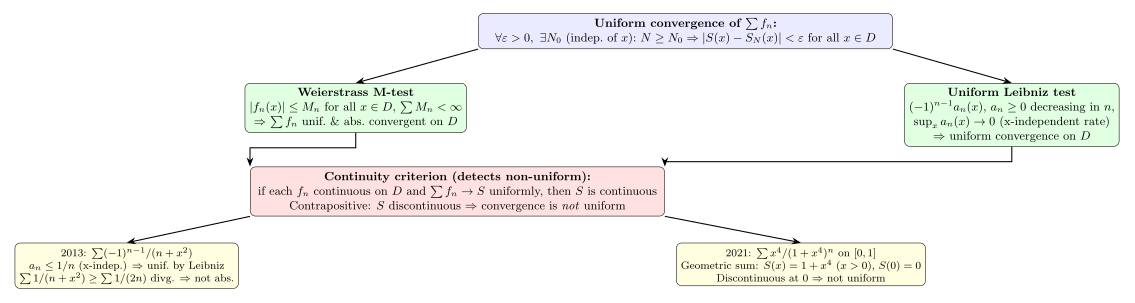
Uniform convergence of a series. The series converges uniformly on if the sequence of partial sums converges uniformly on : for every there exists (independent of ) such that for all .
Weierstrass M-test. If there exist constants with for all and all , and if , then converges uniformly and absolutely on .
Uniform Leibniz test. For an alternating series with : if (i) for all and all , and (ii) as , then the series converges uniformly on . The key is that the bound on must go to with an -independent rate.
Continuity of the uniform limit. If each is continuous on and converges uniformly on , then the sum is continuous on . Contrapositively: a discontinuous pointwise limit immediately implies non-uniform convergence.
Question Archetypes
| Archetype | Recognition |
|---|---|
| series-uniform-convergence | ”Test uniform convergence” of a series or geometric series on an interval |
series-uniform-convergence (3 question(s); 2013, 2015, 2021)
Recognition Cues — Three sub-patterns have appeared: (a) alternating series — apply uniform Leibniz; (b) geometric series on a closed interval — compute the pointwise sum and check its continuity; (c) series of the form — check pointwise convergence first (it may fail entirely for ), then address the sequence/series distinction.
Solution Template
- Identify the series type. Is it alternating? Geometric? A general positive series?
- Pointwise convergence. Find the pointwise limit (if it exists). For geometric series, sum the geometric progression explicitly.
- Test for uniform convergence.
- Alternating: check uniform decay of : find an -independent bound with .
- Geometric/continuous limit test: if the pointwise sum is discontinuous, the convergence is not uniform.
- M-test: if is summable, conclude uniform absolute convergence.
- Test for absolute convergence. Consider for a fixed and compare with a known divergent series (typically harmonic).
- State the conclusion precisely. Distinguish uniform convergence, absolute convergence, and the domain on which each holds.
Worked Example
2013 Paper 2, 2013-P2-Q2c (13 marks)
Show that the series is uniformly convergent but not absolutely convergent for all real .
Let and .
Part 1 — Uniform convergence.
Apply the uniform Leibniz test:
(i) since and . ✓
(ii) for all . ✓
(iii) Uniform decay: for all .
The bound is independent of and . So uniformly.
By the uniform Leibniz test, converges uniformly on . The truncation error satisfies uniformly.
Part 2 — Not absolutely convergent.
For fixed , the absolute-value series is
For , we have , so .
The tail diverges (harmonic). By comparison, diverges for every fixed .
2015 Paper 2, 2015-P2-Q3b (15 marks)
Test the series for uniform convergence.
Let .
Pointwise convergence. At : all terms are ; series converges to .
For : as , . Since diverges, the series diverges for every .
Sequence interpretation (pedagogical standard answer).
The question is commonly interpreted as asking about the sequence (each term), since the series itself has no non-trivial domain of convergence.
- Pointwise limit of : for , (denominator grows as ). At , . So pointwise on .
- Maximum of : by AM-GM, , so , with equality at . Hence for every .
- Since , the convergence is not uniform on .
- On with : for large enough that , the max of on occurs at , where . Convergence is uniform on for any fixed .
2021 Paper 2, 2021-P2-Q1b (10 marks)
Test uniform convergence of on .
Write , .
Pointwise sum. For : all terms ; sum .
For : geometric series with first term and ratio :
Continuity test. The pointwise sum is but . So is discontinuous at .
Conclusion. Each partial sum is continuous on . If the convergence were uniform, the limit would be continuous (uniform limit of continuous functions is continuous). But is discontinuous at . Therefore the series does not converge uniformly on .
Common Traps
- “Uniform decay” must be -independent. In the 2013 problem, works because makes the denominator no smaller than . A bound that depends on does not establish uniform convergence.
- Series diverges vs. sequence converges. The 2015 question is a classic confusion: the sequence pointwise, but the series diverges for (terms go to zero as , and the harmonic series diverges). Address both interpretations if the question is ambiguous.
- Discontinuous limit immediately kills uniform convergence. In the 2021 problem, computing the pointwise sum and noticing the discontinuity at is the entire argument. No need for epsilon-delta: continuity of the uniform limit is a theorem.
- “Not absolutely convergent” is a pointwise statement. For a fixed , the absolute series diverges — that is what the question is asking. It is not asking whether the absolute series diverges uniformly.
Marks-Aware Writing
A 13–15 mark answer for a uniform convergence proof must include: (1) an explicit statement of the test being applied (Leibniz uniform version, M-test, or continuity criterion), (2) verification of all hypotheses of the test with inequalities written out, (3) for non-uniform convergence via discontinuity — display the pointwise sum, identify the discontinuity, and cite the theorem. For the absolute-convergence part, show the comparison with a harmonic tail explicitly.
A 10-mark answer (2021 style) requires: compute the geometric sum for and separately at ; identify the jump; cite the continuity theorem; state the conclusion.
Practice Set
- 2019-P2-Q3a (15 m) — — Hint: identify whether the series is alternating or positive-term; check if the Weierstrass M-test applies or if the limit function detects non-uniform convergence.