Frequency: 2 sub-parts across 2 of 14 years (2016, 2020)
Priority tier: T3
Marks (count): 15 (2)
Average solve time: ~12 min
Difficulty mix: medium 2
Section: A | Dominant type: proof
Why This Chapter Matters
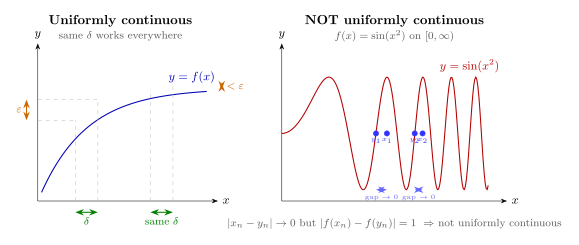
Both questions are 15-mark problems requiring structured multi-step proofs. The 2016 question proves uniform continuity on R via a three-region splitting argument (two tails plus a compact middle), requiring an embedded proof of the Heine-Cantor theorem. The 2020 question disproves uniform continuity via an explicit sequence construction. Together they give both sides of the coin and are the two most likely question patterns for this atom.
Minimum Theory
Uniform continuity.f:I→R is uniformly continuous if for every ε>0 there exists δ>0 (depending only on ε, not on the base point) such that ∣x−y∣<δ⇒∣f(x)−f(y)∣<ε for all x,y∈I.
Heine-Cantor theorem. A continuous function on a closed bounded interval [a,b] is uniformly continuous. Proof by contradiction: if not, for every n there exist un,vn∈[a,b] with ∣un−vn∣<1/n but ∣f(un)−f(vn)∣≥ε0. Bolzano-Weierstrass gives a subsequence unk→c; then vnk→c too (since ∣un−vn∣→0). Continuity gives f(unk),f(vnk)→f(c), contradicting the gap ≥ε0.
Negation of uniform continuity.f is NOT uniformly continuous on I iff there exists ε0>0 and sequences (xn),(yn) in I with ∣xn−yn∣→0 but ∣f(xn)−f(yn)∣≥ε0.
Question Archetypes
Archetype
Recognition
prove-uniform-continuity
function continuous on R with finite limits at ±∞; prove uniformly continuous
disprove-uniform-continuity
function whose oscillations compress (like sin(x2)) on an unbounded interval; disprove
prove-uniform-continuity (1 question; 2016)
Recognition Cues — f:R→R continuous, limx→±∞f(x) finite. The hypothesis on limits at ±∞ is the key signal: the function is “flat” far out, so the tails are automatically uniform; the compact middle piece is handled by Heine-Cantor.
Solution Template
Let ε>0. Use limx→+∞f(x)=L+ to find M+ such that ∣f(x)−L+∣<ε/3 for x>M+.
Similarly find M− for the left tail. Set M=max(M+,M−).
For x,y both in the right tail (M,∞): ∣f(x)−f(y)∣<2ε/3<ε (no constraint on ∣x−y∣). Similarly for the left tail.
Apply Heine-Cantor to [−M−1,M+1] (compact): ∃δ1>0 with ∣x−y∣<δ1⇒∣f(x)−f(y)∣<ε for x,y∈[−M−1,M+1].
Set δ=min(δ1,1). For ∣x−y∣<δ≤1: if both points are in the same tail, use the tail bound; otherwise both lie in [−M−1,M+1] (since ∣x−y∣<1 prevents them being in opposite tails), and use the Heine-Cantor bound.
Conclude f is uniformly continuous on R.
Worked Example
2016 Paper 2, 2016-P2-Q4b (15 marks)
Let f:R→R be a continuous function such that limx→+∞f(x) and limx→−∞f(x) exist and are finite. Prove that f is uniformly continuous on R.
Let ε>0. Denote L+=limx→+∞f(x) and L−=limx→−∞f(x) (finite).
Step 1 — Control the tails.
By the limit at +∞, there exists M+>0 such that x>M+⇒∣f(x)−L+∣<ε/3. Hence for any x,y>M+:
Similarly, there exists M−>0 such that for any x,y<−M−: ∣f(x)−f(y)∣<ε. (T−)
Set M=max(M+,M−)+1.
Step 2 — Heine-Cantor on the compact middle.
The interval [−M−1,M+1] is closed and bounded, hence compact. Since f is continuous on a compact set, f is uniformly continuous on [−M−1,M+1] (Heine-Cantor):
(Proof of Heine-Cantor.) Suppose not: then for some ε0>0 and every n∈N there exist un,vn∈[−M−1,M+1] with ∣un−vn∣<1/n but ∣f(un)−f(vn)∣≥ε0. By Bolzano-Weierstrass, (unk) has a convergent subsequence unk→c∈[−M−1,M+1]. Since ∣unk−vnk∣<1/nk→0, also vnk→c. Continuity of f gives f(unk)→f(c) and f(vnk)→f(c), so ∣f(unk)−f(vnk)∣→0, contradicting ≥ε0. □
So there exists δ1>0 such that for x,y∈[−M−1,M+1] with ∣x−y∣<δ1: ∣f(x)−f(y)∣<ε. (C)
Step 3 — Stitch with δ=min(δ1,1).
Let x,y∈R with ∣x−y∣<δ≤1. Since ∣x−y∣<1, the points x and y cannot lie in opposite tails (right tail and left tail are separated by more than 1):
Both x,y>M: use (T+), ∣f(x)−f(y)∣<ε.
Both x,y<−M: use (T−), ∣f(x)−f(y)∣<ε.
Otherwise: at least one of x,y lies in [−M,M]; since ∣x−y∣<1, both lie in [−M−1,M+1]. With ∣x−y∣<δ≤δ1, (C) gives ∣f(x)−f(y)∣<ε.
In every case ∣f(x)−f(y)∣<ε, and δ depends only on ε (not on x,y).
f is uniformly continuous on R.
Common Traps
The cap δ≤1 is essential so that ∣x−y∣<δ prevents x and y from lying in opposite far tails simultaneously; without this cap the case analysis breaks.
Use ε/3 (not ε/2) in the tail estimate: two triangle-inequality terms sum to 2ε/3<ε.
The problem requires proving Heine-Cantor explicitly (the Bolzano-Weierstrass argument); do not merely cite it without proof.
disprove-uniform-continuity (1 question; 2020)
Recognition Cues — Function like f(x)=sin(x2) on [0,∞), or any function whose oscillations accelerate on an unbounded interval. The question says “prove that f is not uniformly continuous.” Use the sequence-pair method with the negation of the definition.
Solution Template
State the negation of uniform continuity: ∃ε0>0 such that ∀δ>0, ∃x,y with ∣x−y∣<δ but ∣f(x)−f(y)∣≥ε0.
Choose sequences xn,yn so that f(xn)=1 and f(yn)=0 (or similar fixed values) for all n.
Show xn−yn→0 (rationalize if necessary).
Set ε0=1. For any δ>0, pick n large so ∣xn−yn∣<δ; then ∣f(xn)−f(yn)∣=1≥ε0. Conclude not uniformly continuous.
Worked Example
2020 Paper 2, 2020-P2-Q2b (15 marks)
Prove that the function f(x)=sinx2 is not uniformly continuous on the interval [0,∞).
Negation.f is NOT uniformly continuous on [0,∞) iff ∃ε0>0 such that for every δ>0 there exist x,y∈[0,∞) with ∣x−y∣<δ but ∣f(x)−f(y)∣≥ε0.
Take ε0=1. Let δ>0 be arbitrary. Choose n large enough that xn−yn<δ; then
∣xn−yn∣<δyet∣f(xn)−f(yn)∣=1=ε0.
Since δ>0 was arbitrary, no single δ works for ε0=1.
xn=2nπ+2π,yn=2nπ:∣xn−yn∣→0 but ∣f(xn)−f(yn)∣=1.
Common Traps
Choose xn,yn so that xn2 and yn2 differ by a fixed amount (π/2 here) — this forces the function value gap to be a fixed constant (≥ε0), while xn−yn→0 because ⋅ grows.
Rationalizing is essential to show xn−yn→0; the surds individually →∞ and cannot be directly compared.
Citing “the derivative f′(x)=2xcos(x2) is unbounded” is a heuristic, not a proof; the sequence-pair argument is the rigorous method and is what earns marks.
Marks-Aware Writing
15-mark answer (prove-uniform-continuity): Three regions — both tails covered by the limit hypothesis (ε/3 argument), compact middle by Heine-Cantor (with the Bolzano-Weierstrass proof of Heine-Cantor written out), stitching with δ=min(δ1,1). Explain why δ≤1 prevents the opposite-tail interaction.
15-mark answer (disprove-uniform-continuity): State the negation explicitly (2 lines), define xn and yn and compute f(xn),f(yn) (3 lines), rationalize xn−yn→0 (4 lines), close with the ε0=1 argument (3 lines). The rationalization step is where marks are often lost.
Practice Set
2016-P2-Q4b (15 m) — — Hint: split into three regions; set δ=min(δ1,1); prove Heine-Cantor via Bolzano-Weierstrass.
2020-P2-Q2b (15 m) — — Hint: pick xn=2nπ+π/2 and yn=2nπ; rationalize the gap to show xn−yn→0.
Ready to drill what you just read?
Daily Practice turns these patterns into one adaptive set a day —
practised daily until they're automatic, free for everyone.