Real number system as ordered field with LUB property
At a Glance
- Frequency: 2 sub-parts across 2 of 14 years (2013, 2018)
- Priority tier: T3
- Marks (count): 14 (1), 20 (1)
- Average solve time: ~15 min
- Difficulty mix: medium 2
- Section: A | Dominant type: proof
Why This Chapter Matters
This atom covers two fundamental properties of : its topology (every open set decomposes as a countable union of disjoint open intervals) and its ring-homomorphism rigidity (the only ring homomorphisms are and the identity). Both questions are 14–20 marks and require multi-step, structured proofs — making them high-reward questions for candidates who have memorised the argument skeleton. The 2013 question tests topological understanding of open sets; the 2018 question uses the interplay of additive and multiplicative functional equations to force global dichotomy.
Minimum Theory
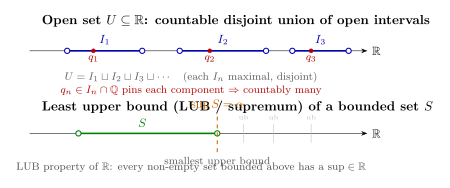
Ordered field with LUB. is a complete ordered field: every non-empty subset bounded above has a least upper bound (supremum) in . The rationals are dense in : between any two real numbers there is a rational, and every non-empty open interval contains a rational.
Structure of open sets. An open set is a set where every point has an open interval neighbourhood inside . For each one can define the maximal open interval through (with possibly ). These maximal intervals are the connected components of ; any two are either equal or disjoint. Each component contains a rational, and distinct components contain distinct rationals, so there are at most countably many.
Functional equations on . Cauchy’s additive equation alone has wild discontinuous solutions (Hamel basis maps). The multiplicative condition forces for , which implies is monotone non-decreasing. A monotone additive map that agrees with the identity on must equal the identity everywhere by density and squeeze.
Question Archetypes
| Archetype | Recognition |
|---|---|
| open-set-structure | ”show every open subset of is a countable union of disjoint open intervals” |
| functional-equation | ” and ; determine all “ |
open-set-structure (1 question; 2013)
Recognition Cues — The question says “open subset of ” and asks you to show it is a “countable disjoint union of open intervals.” The word disjoint (not just union) signals that you need to construct maximal connected components, not merely cover by neighbourhoods.
Solution Template
- Define for each . Set and ; let .
- Show and . Use openness to get -neighbourhood , giving and .
- Show is maximal: if is an open interval with , then by definition.
- Prove distinctness implies disjointness. If , their union is an open interval in containing both and , so by maximality.
- Count via rationals. Each is a non-empty open interval contains a rational . Distinct components have distinct rationals (they are disjoint). The map is injective into , so there are countably many components.
- Conclude , a countable disjoint union of open intervals.
Worked Example
2013 Paper 2, 2013-P2-Q2d (14 marks)
Show that every open subset of is a countable union of disjoint open intervals.
Let be open. We construct the maximal interval through each point.
Step 1 — Maximal interval .
Fix . Define
Since is open, there exists with , so . Set .
For any with : by definition of there exists with , so . Similarly for . Hence . Conversely, any open interval contained in satisfies by definition of , so is the largest such interval.
Step 2 — Distinct components are disjoint.
Suppose . Then is an open interval containing both and , and . By maximality (since is the largest interval through in ), and similarly . Therefore .
Step 3 — Countably many components.
The components (each distinct taken once) partition . Each component is a non-empty open interval, so it contains a rational . Distinct components are disjoint, hence the map is injective into . Since is countable, there are at most countably many components.
Common Traps
- Partition into maximal connected components, not arbitrary open balls. Without maximality the intervals need not be disjoint.
- The intervals can be unbounded; for example gives two (possibly unbounded) intervals.
- The proof that distinct components are disjoint requires showing ; do not claim disjointness without this argument.
- Countability via rationals: each component gets a different rational because the components are disjoint; the injectivity step must be explicit.
functional-equation (1 question; 2018)
Recognition Cues — The problem gives two functional equations: (Cauchy additive) AND (multiplicative). The goal is to show only or are possible globally (not just pointwise).
Solution Template
- Evaluate at in the multiplicative equation to get .
- If : show using .
- Assume . Use additivity to show for , then for .
- Derive monotonicity from the multiplicative law: for ; use additivity to deduce is non-decreasing.
- Squeeze with rationals: for any choose in ; monotonicity and Step 3 give ; density of forces .
- Conclude: or .
Worked Example
2018 Paper 2, 2018-P2-Q4a (20 marks)
Suppose satisfies and for all . Show that either for all or for all .
Step 1 — .
Set in :
Case : for any , , so . Done.
Henceforth assume .
Step 2 — fixes .
From additivity: and . By induction, for all . For with , : additivity gives and , so
Step 3 — Monotonicity via squares.
For , write ; then . Hence maps non-negatives to non-negatives. If then , so , i.e., is non-decreasing.
Step 4 — Squeeze to identity.
Let be arbitrary. Choose rationals . Monotonicity and Step 2 give
Since is dense, we may choose and , so .
Common Traps
- Additivity alone has wild discontinuous solutions (Hamel-basis maps over ). The multiplicative law is essential — it forces non-negativity on squares, hence monotonicity.
- The conclusion is globally dichotomous: forces everywhere; once , equals the identity everywhere. There is no pointwise mixture.
- The squeeze step needs both density of and monotonicity; state and use both.
Marks-Aware Writing
14-mark answer (open-set-structure): Present all three steps — construct , prove distinct components disjoint, count via rationals — with explicit justifications for and for the injectivity . Conclude with the boxed statement.
20-mark answer (functional-equation): All four steps must appear with full justification. Write out the case split explicitly. The monotonicity paragraph (Step 3) must explain why , and the squeeze paragraph must invoke density of by name.
Practice Set
- 2013-P2-Q2d (14 m) — — Hint: construct maximal open intervals, then inject into .
- 2018-P2-Q4a (20 m) — — Hint: the multiplicative law at is the first move; monotonicity follows from .