Improper integrals (analysis perspective)
At a Glance
- Frequency: 4 sub-parts across 4 of 14 years (2014, 2022, 2024, 2026)
- Priority tier: T3
- Marks (count): 10 (3)
- Average solve time: ~5 min
- Difficulty mix: easy 3
- Section: A | Dominant type: proof
Why This Chapter Matters
Improper integrals appear in every UPSC Paper 2 Section A diet — three times in the last six years alone — and the question is always the same shape: identify the singularities, bound the integrand, invoke the comparison test, and state convergence. Mastering this archetype is essentially free marks once the two-step pattern is internalised. The comparison and limit-comparison tests are also the gateway to the harder series-convergence problems in RA-17.
Minimum Theory
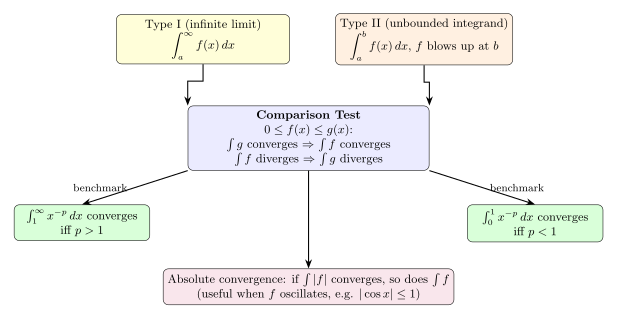
Definition (Type I and Type II). An improper integral of Type I is when the limit exists and is finite. An improper integral of Type II arises when is unbounded near an endpoint: (or ). If the integral has singularities at both endpoints, split the interval and require both parts to converge independently.
Comparison Test. Suppose for all . Then: converges converges; diverges diverges. The same test applies for Type II integrals near a singular endpoint.
Limit Comparison Test. If and with , then and converge or diverge together. p-test benchmarks: converges iff ; converges iff .
Absolute convergence. If converges, so does . This lets you handle oscillating integrands (e.g.\ ) by bounding and comparing the absolute value.
Question Archetypes
| Archetype | Recognition |
|---|---|
| improper-convergence | ”Test convergence of ”; integrand has limit or blows up at endpoint |
improper-convergence (3 question(s); 2014, 2022, 2024)
Recognition Cues — The question says “test convergence” or “examine convergence”. Either the upper limit is (Type I) or the integrand blows up at an endpoint (Type II: look for near , near , etc.). Never just substitute limits blindly — first locate every singularity.
Solution Template
- Locate singularities. Identify whether the problem is Type I ( limit) or Type II (unbounded integrand), or both. For a bounded interval, check both endpoints.
- Split if necessary. If two singularities exist (e.g. 2024’s integral over ), split and treat each piece independently.
- Choose a comparison or benchmark. Use as the standard comparison function. For oscillating integrands, bound or and work with absolute values.
- State and apply the test. Write (or compute the limit ratio), cite the comparison test, and conclude for first (using a known integral or p-test).
- Conclude. State whether the integral converges or diverges. A brief bound on the value (if easy) earns bonus marks.
Worked Example
2014 Paper 2, 2014-P2-Q1b (10 marks)
Test the convergence of the improper integral .
Locate singularity. The upper limit is (Type I). At the integrand is finite and positive, so no issue at the lower endpoint.
Bound the integrand. For , we have , so . Taking reciprocals:
Therefore
Apply comparison. The integral converges (p-test with ). By the comparison test, the smaller positive integrand also gives a convergent integral.
Bonus bound. The lower bound gives , so the integral lies in .
2022 Paper 2, 2022-P2-Q1c (10 marks)
Test the convergence of .
Locate singularity. Type I ( limit); the integrand is bounded and continuous on .
Use absolute convergence. Since :
Evaluate the bounding integral.
Conclude. By comparison, , so the integral converges absolutely, hence converges.
2024 Paper 2, 2024-P2-Q1c (10 marks)
Test the convergence of .
Locate singularities. The integrand is potentially singular at both endpoints: as , and as . Split:
Near . On , the factor is bounded (between and ). So the behaviour is governed by alone:
Since is integrable near and is bounded there, the product is integrable. No issue at .
Near . As , (finite and nonzero). By limit comparison with :
Since converges, the limit comparison gives convergence of as well.
Conclude. Both pieces converge, so
Common Traps
- Missing the lower endpoint. In the 2024 integral, is the “obvious” singularity but is bounded near — the piece near is actually fine. Students who only check one endpoint lose half the marks.
- Wrong direction of comparison. The 2014 integrand is smaller than (because ). Convergence of the larger function implies convergence of the smaller, not the other way.
- Forgetting absolute convergence for oscillating integrands. In the 2022 integral, oscillates. The correct route is to bound , prove absolute convergence, and deduce convergence. Do not try to integrate directly.
- Confusing p-test ranges. converges iff ; converges iff . The exponent threshold flips at the two standard limits.
Marks-Aware Writing
A 10-mark answer requires: (1) identify singularity type, (2) state and establish the bound with explicit inequalities, (3) compute or cite the comparison integral, (4) invoke the comparison test by name, (5) state the conclusion. Writing down the exact inequality and referencing the p-test or known antiderivative are the two steps students most often skip.
Practice Set
- 2019-P2-Q4c (15 m) — — Hint: likely a Type II integral; check both endpoints and split if needed.