Cauchy sequences; completeness of R
At a Glance
- Frequency: 3 sub-parts across 3 of 14 years (2020, 2024, 2025)
- Priority tier: T3
- Marks (count): 10 (1), 15 (2)
- Average solve time: ~10 min
- Difficulty mix: easy 1, medium 2
- Section: A | Dominant type: proof
Why This Chapter Matters
Cauchy sequences are the backbone of completeness and appear consistently at 10–15 marks. The three question types are: (1) prove a contractive-type sequence is Cauchy by geometric telescoping (2020); (2) apply Cauchy’s general principle to establish convergence of a concrete series (2024); (3) define Cauchy sequences and prove every convergent sequence is Cauchy, then discuss completeness (2025). All three have tight, reproducible proof templates. The 2025 question is the most theoretical — mastering it gives the clearest understanding of why completeness distinguishes from .
Minimum Theory
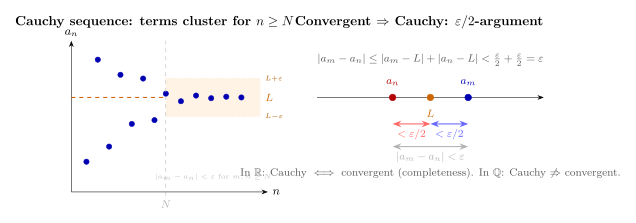
Definition. A sequence in is Cauchy if for every there exists such that for all . The definition involves the terms themselves, with no reference to a limit value.
Cauchy criterion (completeness of ). In , a sequence is convergent if and only if it is Cauchy. The forward direction (convergent Cauchy) follows from the -triangle argument. The backward direction (Cauchy convergent) is the completeness of ; is not complete (decimal truncations of are Cauchy in but have no rational limit).
Geometric telescoping. If with and , then for :
This bound is independent of , so choosing with completes the Cauchy argument.
Question Archetypes
| Archetype | Recognition |
|---|---|
| cauchy-contraction | with ; prove Cauchy |
| cauchy-criterion | examine convergence of a concrete partial-sum sequence via Cauchy’s general principle |
| cauchy-convergent-proof | define Cauchy; prove convergent Cauchy; discuss completeness |
cauchy-contraction (1 question; 2020)
Recognition Cues — The hypothesis gives a contractive inequality with for all . The question asks to prove is Cauchy. No explicit formula for is given — the proof is purely from the contraction estimate.
Solution Template
- Set ; iterate the contraction to get .
- For , telescope: (bound independent of ).
- Note so the bound .
- Given , choose so ; conclude Cauchy.
Worked Example
2020 Paper 2, 2020-P2-Q1c (10 marks)
Prove that the sequence satisfying , , for all , is a Cauchy sequence.
Step 1 — Geometric bound on consecutive differences.
Let for . By hypothesis for . Iterating:
If the sequence is constant from , hence trivially Cauchy. Assume .
Step 2 — Triangle inequality bound for .
For , telescoping and the triangle inequality give:
The bound is independent of .
Step 3 — Cauchy criterion.
Since , , so .
Let . Choose so large that . Then for all :
Common Traps
- Sum the geometric series to — a constant independent of . Leaving an -dependent partial sum means the bound cannot be used to pick a single .
- The condition is used in two places: summing the geometric series, and sending . With neither works (e.g., satisfies but is not Cauchy).
- Treat (sequence is immediately constant) as a trivial base case before the main argument.
cauchy-criterion (1 question; 2024)
Recognition Cues — The sequence is a partial sum of a series with explicitly given terms. The question says “using Cauchy’s general principle, examine the convergence.” You must bound for and show it can be made independent of .
Solution Template
- State Cauchy’s general principle explicitly.
- For , write .
- Bound by a term of a known convergent series (here: , geometric).
- Sum the tail to a bound depending only on (not ); show this .
- Choose from the tail bound; conclude convergent.
Worked Example
2024 Paper 2, 2024-P2-Q2a (15 marks)
Using Cauchy’s general principle of convergence, examine the convergence of , where .
Cauchy’s general principle. converges for every there exists such that for all .
Step 1 — Bound the tail.
For :
Factorial bound: for all (induction: ; ). Hence .
Step 2 — Verify Cauchy criterion.
The bound is independent of and as . Given , choose with . Then for all :
By Cauchy’s general principle:
Common Traps
- The bound must hold for all (including ); confirm it is independent of .
- The bound is the right one; the weaker does not yield a summable tail.
- Do not prove the series converges by citing — the question specifically asks for the Cauchy characterisation.
cauchy-convergent-proof (1 question; 2025)
Recognition Cues — Asks you to (a) define a Cauchy sequence, (b) prove every convergent sequence is Cauchy, and (c) discuss the importance of the Cauchy condition. Three clearly labelled parts are expected.
Solution Template
- Definition: state the - definition of a Cauchy sequence explicitly.
- Theorem + Proof: convergent Cauchy via the triangle argument.
- Importance: (i) intrinsic criterion — no need to know the limit; (ii) completeness of — Cauchy convergent; (iii) is not complete (example); (iv) foundational role in analysis.
Worked Example
2025 Paper 2, 2025-P2-Q2a (15 marks)
Define Cauchy sequence and prove that every convergent sequence of real numbers is a Cauchy sequence. What is the importance of Cauchy condition?
Definition. A sequence is a Cauchy sequence if for every there exists such that
Intuitively: the terms become arbitrarily close to one another, without reference to any limit.
Theorem. Every convergent sequence of real numbers is a Cauchy sequence.
Proof. Suppose : for every there exists with for all . For any , the triangle inequality gives:
Hence is Cauchy.
Importance of the Cauchy condition.
-
Intrinsic convergence test. Cauchy’s condition uses only the terms of the sequence — no prior knowledge of the limit. This allows us to establish convergence even when the limit is unknown.
-
Completeness of . The converse (every Cauchy sequence in converges) is the completeness of . Together:
-
is not complete. The decimal truncations of form a Cauchy sequence in but converge to an irrational; completeness is a special feature of .
-
Foundational role. Completeness underlies convergence of series (Cauchy series test), uniform convergence, Cantor’s construction of from , the Banach fixed-point theorem, and the general theory of Banach spaces.
Common Traps
- Use (not ) in the triangle inequality step; otherwise the bound gives and a separate substitution is needed.
- The importance section must include completeness and a -counterexample for full marks; omitting it loses the third of the answer.
Marks-Aware Writing
10-mark answer (cauchy-contraction): Four steps — geometric iteration, telescoping bound, send to zero, - conclusion. Each step needs one or two lines of algebra. Handle in one sentence.
15-mark answer (cauchy-criterion): State Cauchy’s principle first (2 lines), establish by induction (4 lines), bound (3 lines), choose and close (3 lines).
15-mark answer (cauchy-convergent-proof): Three sections of roughly equal length — definition (3 lines), theorem + proof (5 lines), importance (6–8 lines covering at least 3 points). The importance section carries roughly a third of the marks.
Practice Set
- 2020-P2-Q1c (10 m) — — Hint: iterate to ; the final bound on must be free of .
- 2024-P2-Q2a (15 m) — — Hint: use to reduce to a geometric tail; state Cauchy’s principle first.
- 2025-P2-Q2a (15 m) — — Hint: three-part structure — definition, proof, importance with at least three enumerated points.