Laplace equation: Dirichlet/Neumann, separation of variables
At a Glance
Frequency: 5 sub-parts across 5 of 14 years (2017, 2018, 2024, 2025, 2026)
Priority tier: T3
Marks (count): 10 (1), 20 (3)
Average solve time: ~17 min
Difficulty mix: hard 2, medium 1, easy 1
Section: B | Dominant type: proof
Why This Chapter Matters
Every Laplace equation question carries 10–20 marks and involves one of three techniques: the energy-integral uniqueness proof, separation of variables on a rectangle or annulus, or Fourier transform derivation of the Poisson kernel. The 2024 and 2025 papers together accounted for 40 marks from this one atom. The hardest trap — encountered in 2018 — is that the boundary datum cos(θ/2) has period 4π, not 2π, so it must be expanded in a Fourier series rather than matched to a single harmonic. Knowing this trap is worth 10 marks on its own.
Minimum Theory
Laplace’s equation.∇2u=uxx+uyy=0 (or in polar: urr+r1ur+r21uθθ=0). A solution is called harmonic. Harmonic functions satisfy the maximum principle: on a bounded domain Ω, u attains its max and min on the boundary ∂Ω.
Uniqueness via Green’s identity. Green’s first identity:
∬S(u∇2u+∣∇u∣2)dA=∮Γu∂n∂uds.
For the Dirichlet problem (u prescribed on Γ): if two solutions u1,u2 both satisfy the same BVP, their difference v=u1−u2 is harmonic with v=0 on Γ. Applying the identity to v gives ∬S∣∇v∣2dA=0, hence v≡0.
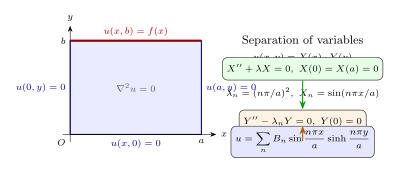
Separation of variables on a rectangle. For u(x,y)=X(x)Y(y):
X′′+λX=0 with BCs on x gives the Sturm–Liouville problem; the eigenvalues are λn=(nπ/a)2.
Homogeneous edges (zero) give sine eigenfunctions Xn=sin(nπx/a).
The Y-equation Y′′−λnY=0 with Y(0)=0 gives Yn=sinh(nπy/a).
The non-homogeneous top edge u(x,b)=f(x) is matched by a Fourier sine series.
”Show that the solution on the half-plane is given by the Poisson integral.”
uniqueness-proof (1 question; 2017)
Recognition Cues
“Prove that any solution satisfying these conditions is unique.”
The setup is the Dirichlet problem for Poisson’s equation: ∇2w=f with w prescribed on Γ.
Solution Template
Suppose two solutionsw1, w2. Define u=w1−w2.
Establish the homogeneous problem:∇2u=0 in S; u=0 on Γ.
Apply Green’s first identity to u: ∬S∣∇u∣2dA=∮Γu∂u/∂nds=0 (boundary term vanishes since u=0 on Γ).
Conclude:∣∇u∣2≥0 and its integral is 0, so ∣∇u∣2≡0⇒u=const. Boundary condition u=0 on Γ forces u≡0.
Worked Example
2017 Paper 2, 2017-P2-Q5d (10 marks)
Prove uniqueness for ∇2w=f in S with w=g on Γ.
Step 1. Suppose w1 and w2 both satisfy the problem. Let u=w1−w2. By linearity, ∇2u=0 in S and u=0 on Γ.
Step 2. Apply Green’s first identity to u (with u in both positions):
∬S(u∇2u+∣∇u∣2)dA=∮Γu∂n∂uds.
The right side is 0 (since u=0 on Γ). The first term on the left is 0 (since ∇2u=0). Hence:
∬S∣∇u∣2dA=0.
Step 3. Since ∣∇u∣2=ux2+uy2≥0 everywhere and integrates to 0, we have ∣∇u∣2≡0, so u is constant in S. By continuity and u=0 on Γ, this constant is 0. Hence u≡0, i.e. w1≡w2. □
Alternative. By the maximum principle, a harmonic function on Sˉ attains its max and min on Γ. Since u=0 on Γ: 0≤u≤0, so u≡0.
Common Traps
The difference u satisfies the homogeneous Laplace equation (∇2u=0, not f); both the f terms cancel. This reduction is the first step and must appear explicitly.
For Neumann BCs (∂u/∂n=0 on Γ): the boundary integral still vanishes, and the same Green’s argument gives u= const — but only uniqueness up to an additive constant.
laplace-rectangle (1 question; 2025)
Recognition Cues
“Solve uxx+uyy=0 on a rectangle [0,a]×[0,b].”
Three zero BCs (u=0 on three edges) and one data edge (u=f(x) on the top).
The wrong sign of the separation constant (λ<0) gives exponentials/hyperbolics in x and sinusoids in y, which cannot satisfy X(0)=X(a)=0 nontrivially.
Use sinh(nπy/a), not cosh(nπy/a): sinh(0)=0 satisfies Y(0)=0, but cosh(0)=1=0.
The denominator of Bn is sinh(nπb/a), not 1. Omitting it loses the final marks.
laplace-polar (1 question; 2018)
Recognition Cues
“Steady temperature in an annulus a≤r≤b” with a trigonometric outer boundary condition.
The boundary condition contains cos(θ/2) or sin(θ/k) for non-integer k — a period trap.
Key trap. The general Laplace solution in an annulus is 2π-periodic in θ (since T must be single-valued). A datum like cos(θ/2) has period 4π — it is not a single 2π-periodic harmonic. It must be expanded in a Fourier series in {1,cosnθ,sinnθ} on [0,2π].
Solution Template
General solution:T=A0+B0lnr+∑n=1∞(Anrn+Bnr−n)cosnθ+(Cnrn+Dnr−n)sinnθ.
Fourier-expand the outer BC on [0,2π]. For Kcos(θ/2), only sine terms survive (it’s odd about θ=π): bn=π(4n2−1)8Kn.
Match modes. For each n: apply inner BC (T(a,θ)=0) and outer BC mode coefficients. Solve the 2×2 system for Cn,Dn (sine family only).
Worked Example
2018 Paper 2, 2018-P2-Q8c (20 marks)
Annulus a≤r≤b; T(a,θ)=0; T(b,θ)=Kcos(θ/2). Find the temperature distribution.
Fourier expansion of Kcos(θ/2) on [0,2π]: all cosine and constant terms vanish (odd symmetry about π); the sine coefficients are:
bn=π1∫02πKcos2θsinnθdθ=π(4n2−1)8Kn.
So Kcos(θ/2)=∑n=1∞π(4n2−1)8Knsinnθ for 0<θ<2π.
Match modes (only sine family survives). For each n, the radial function Rn(r)=Cnrn+Dnr−n satisfies:
Rn(a)=0⇒Dn=−Cna2n.Rn(b)=π(4n2−1)8Kn.
The decay condition at y=∞ is essential — without it, you cannot choose between e−∣k∣y and e+∣k∣y.
The two halves of the Poisson kernel integral (k<0 and k>0) both converge to y±ix1; adding them gives the 2y numerator.
Convolution theorem direction: f∗g=f^⋅g^, so Φ=F⋅e−∣k∣y inverts to a convolution.
Marks-Aware Writing
10-mark uniqueness: Three steps: difference is harmonic with zero boundary data; apply Green’s identity (write it out); conclude gradient vanishes and boundary forces u=0. State both hypotheses in step 3 explicitly (∣∇u∣2≥0 and integral = 0 implies identically 0).
20-mark separation of variables: Write out the full separation (all three steps: ODE for X, eigenvalue problem, ODE for Y). Justify why cosh is excluded (Y(0)=0). Write the superposition. Derive the Fourier coefficient formula with the correct sinh denominator.
20-mark Fourier transform (2024): Show each step: FT of PDE, ODE solution, decay argument, application of BC, convolution theorem, Poisson kernel computation. Don’t skip the kernel calculation — it’s worth multiple marks.
Practice Set
(No additional practice items in the scaffold — the four worked examples cover all archetypes.)
Ready to drill what you just read?
Daily Practice turns these patterns into one adaptive set a day —
practised daily until they're automatic, free for everyone.