Frequency: 7 sub-parts across 7 of 14 years (2013, 2015, 2017, 2020, 2022, 2024, 2025)
Priority tier: T2
Marks (count): 10 (4), 15 (3)
Average solve time: ~11 min
Difficulty mix: easy 2, medium 4, hard 1
Section: B | Dominant type: computation
Why This Chapter Matters
Moment of inertia appears in 7 of the last 14 years — consistently in the compulsory part (Q5e) or the optional Section B problems — making it one of the most reliable Paper 2 computation atoms. The range is broad: spheres about a diagonal of a square (2013), hemispheres by integration (2015), elliptic laminas via the pedal relation (2017), triangular laminas via area coordinates (2020), the hard cone-about-slant-side via the inertia tensor (2022), an elliptic disc with non-uniform density (2024), and a cylinder optimization (2025). The unifying skill is recognising which tool applies: coordinate integration for volumes with clean boundaries, the parallel-axis theorem for shifted axes, the perpendicular-axis theorem for flat laminas, and the inertia tensor for arbitrary axes through a symmetric body.
Minimum Theory
Definition. The moment of inertia of a body of mass M about an axis ℓ is
I=∫r2dm,
where r is the perpendicular distance from each mass element dm to ℓ.
Standard results (memorise these):
Body (mass M)
Axis
I
Solid sphere, radius a
Any diameter
52Ma2
Solid cylinder, radius R, length L
Cylinder axis
21MR2
Solid cylinder, radius R, length L
Transverse axis through centre
12M(3R2+L2)
Solid cone, base a, height h, apex at origin
Symmetry axis
103Ma2
Solid cone, base a, height h, apex at origin
Transverse axis through apex
203M(a2+4h2)
Elliptic lamina, semi-axes a,b
Major axis (through centre)
41Mb2
Elliptic lamina, semi-axes a,b
Minor axis (through centre)
41Ma2
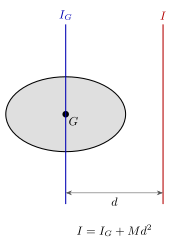
Parallel-axis theorem. If IG is the moment of inertia about an axis through the centre of mass G, then the moment of inertia about any parallel axis at distance d is
I=IG+Md2.
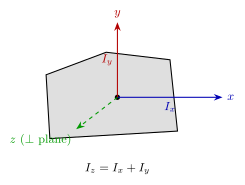
Perpendicular-axis theorem (laminas only). For a flat lamina in the xy-plane:
Iz=Ix+Iy,
where Ix,Iy are moments about the x- and y-axes lying in the lamina’s plane, and Iz is the moment about the z-axis perpendicular to the lamina.
Inertia tensor. For a body with a symmetry axis, the inertia tensor at a point on that axis is diagonal. For a cone with apex at the origin and symmetry axis z:
I=Ix000Ix000Iz.
The moment of inertia about an axis with unit direction n^=(n1,n2,n3) through the apex is
In^=n^TIn^=n12Ix+n22Ix+n32Iz.
Setting up the integral. For a uniform body of density ρ:
Spherical:dV=r2sinϕdrdϕdθ; r⊥2=(x2+y2)=r2sin2ϕ for the z-axis.
Cylindrical:dV=sdsdϕdz; r⊥2=s2 for the z-axis, r⊥2=y2+z2=s2sin2ϕ+z2 for the x-axis.
Elliptic: substitute x=ascosϕ, y=bssinϕ (Jacobian abs) for regions bounded by an ellipse.
Question Archetypes
All seven questions share the single archetype moment-of-inertia. The technique varies:
Sub-technique
When to use
Parallel-axis theorem
Axis parallel to a known axis, at a known distance
Spherical integration
Hemisphere, sphere, or spherical shell
Elliptic lamina (pedal relation)
MI about a general diameter or tangent of an ellipse
Area-coordinate integration
Triangular lamina about an arbitrary axis through a vertex
Inertia tensor
Axis not aligned with symmetry axis; body at origin
Elliptic-coordinate integration
Region bounded by an ellipse with non-trivial density
Cylindrical integration + optimisation
Right circular cylinder; MI minimisation for fixed mass
Write Iα=sin2αIOy+cos2αIOx=4M(a2sin2α+b2cos2α) using the vanishing product of inertia.
Apply the ellipse pedal relation 1/r2=cos2α/a2+sin2α/b2 to convert a2sin2α+b2cos2α=a2b2/r2.
For the tangent: use the parallel central diameter (at perpendicular distance p) plus the parallel-axis theorem.
Area-coordinate integration (2020 type):
Parametrise: AP=uAB+vAC with u,v≥0, u+v≤1. Mass element dm=2Mdudv.
Perpendicular distance from axis through A: δ=uβ+vγ (linear in u,v).
I=2M∬u+v≤1(uβ+vγ)2dudv. Use ∬u2=∬v2=1/12 and ∬uv=1/24.
Inertia tensor (2022 type):
Exploit symmetry: inertia tensor at the apex is diagonal with Ix=Iy=Iapex,perp, Iz=Iaxis.
Slant direction n^=(a,0,h)/a2+h2: apply In^=n12Ix+n32Iz.
Cylindrical integration (2025 type):
Set up Izz=ρ∭s2⋅sdsdϕdz and Ixx=ρ∭(s2sin2ϕ+z2)⋅sdsdϕdz.
For the optimisation: substitute the volume constraint V=πR2L=const to eliminate R; differentiate Ixx(L) and set to zero.
Worked Example(s)
2013 Paper 2, 2013-P2-Q5e (10 marks)
Four solid spheres A,B,C,D, each of mass m and radius a, placed at the corners of a square of side b. Find the MI about a diagonal.
Place the square with corners A=(b/2,b/2), B=(−b/2,b/2), C=(−b/2,−b/2), D=(b/2,−b/2). Diagonal AC lies along y=x.
Perpendicular distance from each corner to y=x:
A,C: on the diagonal, d=0.
B,D: distance =∣b/2−(−b/2)∣/2=b/2, so d2=b2/2.
MI of each solid sphere about any axis through its CM: IG=52ma2.
By the parallel-axis theorem:
I=A,C2⋅52ma2+B,D2⋅(52ma2+m⋅2b2)=58ma2+mb2.
I=m(58a2+b2).
Common Traps
The off-diagonal spheres have perpendicular distance b/2 to the diagonal, so d2=b2/2 — not b2.
A sphere’s MI through its CM is the same for any axis (spherical symmetry), so the parallel-axis theorem applies without choosing a specific axis direction.
Don’t forget the two on-diagonal spheres — they contribute 52ma2 each, not zero.
2015 Paper 2, 2015-P2-Q5e (10 marks)
Find the MI of a solid uniform hemisphere x2+y2+z2=a2, z≥0, mass m, about the z-axis.
Density ρ=m/V=m/(32πa3)=3m/(2πa3).
In spherical coordinates, x2+y2=r2sin2ϕ:
Iz=ρ∫02πdθ∫0π/2∫0ar2sin2ϕ⋅r2sinϕdrdϕ.
Factor:
Iz=ρ⋅(2π)⋅5a5⋅∫0π/2sin3ϕdϕ.
For the angular integral, substitute u=cosϕ:
∫0π/2sin3ϕdϕ=∫01(1−u2)du=1−31=32.
Iz=2πa33m⋅2π⋅5a5⋅32=a33m⋅152a5=52ma2.
Iz=52ma2.
The result equals the MI of a full sphere of the same mass — expected by z-symmetry.
Common Traps
In spherical coordinates, the square distance from the z-axis is r2sin2ϕ, not r2.
The upper hemisphere has ϕ∈[0,π/2], not [0,π].
∫0π/2sin3ϕdϕ=2/3 via u=cosϕ: write sin3ϕ=sinϕ(1−cos2ϕ).
2017 Paper 2, 2017-P2-Q5e (10 marks)
Show the MI of an elliptic area, mass M, semi-axes a,b, about a semi-diameter of length r is 41Mr2a2b2. Prove the MI about a tangent is 45Mp2, where p is the distance from the centre to the tangent.
Standard moments. For a uniform elliptic lamina:
IOx=4Mb2,IOy=4Ma2,Ixy=0.
MI about a central diameter. The diameter in direction α has perpendicular distance ∣xsinα−ycosα∣ from a general point. Since Ixy=0:
Iα=sin2α⋅IOy+cos2α⋅IOx=4M(a2sin2α+b2cos2α).
The semi-diameter length r in direction α satisfies the ellipse equation: r2cos2α/a2+r2sin2α/b2=1, giving
r21=a2b2b2cos2α+a2sin2α⟹a2sin2α+b2cos2α=r2a2b2.
Therefore:
Idiameter=4M⋅r2a2b2.
MI about a tangent. Let the tangent be parallel to the central diameter with semi-length r′, at perpendicular distance p from the centre. The MI about the parallel central diameter is 4Ma2b2/r′2=4Mp2 (since r′2=a2b2/p2 by the same pedal relation). By the parallel-axis theorem:
Itangent=4Mp2+Mp2=45Mp2.
Common Traps
IOx=Mb2/4 (spread in y, semi-axis b) and IOy=Ma2/4; swapping a and b is the most common error.
The central diameter parallel to the tangent has direction equal to the tangent direction, not the conjugate diameter. Get the direction right before applying the pedal relation.
The 45=41+1 mnemonic: 41 from the central-diameter MI, plus 1 from the parallel-axis shift Mp2.
2020 Paper 2, 2020-P2-Q5e (10 marks)
Prove the MI of a triangular lamina ABC about any axis through A in its plane is 6M(β2+βγ+γ2), where β,γ are the perpendicular distances from B,C to the axis.
Area-coordinate setup. Write AP=uAB+vAC for a general point P, with u,v≥0, u+v≤1. The mass element is dm=2Mdudv (since the Jacobian of the map to Cartesian is 2Δ, the triangle area, and σ=M/Δ, giving dm=σ⋅2Δdudv=2Mdudv; check: ∫01∫01−u2Mdvdu=M ✓).
Perpendicular distance. The distance from P to the axis through A is linear in position and vanishes at A (where u=v=0), equals β at B (where u=1,v=0), and equals γ at C (where u=0,v=1):
δ(u,v)=uβ+vγ.
Integration. Standard moments over the unit simplex {u,v≥0,u+v≤1}:
∬u2dudv=121,∬v2dudv=121,∬uvdudv=241.
The mass element dm=2Mdudv: the factor 2 comes from σ⋅2Δ (not Mdudv).
The cross term contributes βγ: the integral ∬uv=1/24, and 2βγ⋅2M⋅1/24=Mβγ/6 ✓.
Verify the simplex integrals: ∫01u2(1−u)du=1/3−1/4=1/12.
2022 Paper 2, 2022-P2-Q6c (15 marks)
Find the MI of a right circular solid cone (mass M, height h, base radius a) about one of its slant sides.
Place the cone with apex at the origin, axis along z, base at z=h.
Inertia tensor at the apex. By the cone’s rotational symmetry:
I=Ix000Ix000Iz,Iz=103Ma2,Ix=Iy=203M(a2+4h2).
Slant direction. A slant side runs from the apex (0,0,0) to the base point (a,0,h); the unit direction is n^=(a,0,h)/a2+h2.
MI formula.In^=nx2Ix+nz2Iz (since ny=0):
In^=a2+h2a2⋅203M(a2+4h2)+a2+h2h2⋅103Ma2.
Combine over the common denominator 20(a2+h2):
In^=20(a2+h2)3M[a2(a2+4h2)+2a2h2]=20(a2+h2)3Ma2(a2+6h2).
Islant=20(a2+h2)3Ma2(a2+6h2).
Common Traps
Iz=3Ma2/10 (axis) and Ix=3M(a2+4h2)/20 (transverse through apex) — do not confuse or swap.
The slant direction from the apex is (a,0,h)/a2+h2; choose coordinates so ny=0.
Final numerator: a2(a2+4h2)+2a2h2=a2(a2+4h2+2h2)=a2(a2+6h2).
2024 Paper 2, 2024-P2-Q6c (15 marks)
Find the MI of a quadrant of the elliptic disc x2/a2+y2/b2≤1 (first quadrant, mass M, density ∝xy) about the axis through the centre perpendicular to the plane.
Elliptic-coordinate substitution. Set x=arcosθ, y=brsinθ for r∈[0,1], θ∈[0,π/2]. Jacobian ∣J∣=ab⋅r. Density ρ(x,y)=kxy for some constant k.
Find k from total mass:M=∫0π/2∫01k(arcosθ)(brsinθ)⋅abrdrdθ=ka2b2∫0π/22sin2θdθ∫01r3dr=ka2b2⋅21⋅41=8ka2b2.
Hence k=8M/(a2b2).
Compute I (r⊥2=x2+y2=r2(a2cos2θ+b2sin2θ)):
I=k⋅2a2b2∫01r5dr∫0π/2(a2cos2θ+b2sin2θ)sin2θdθ.
For the angular integral, substitute u=sin2θ:
∫0π/2(a2cos2θ+b2sin2θ)sin2θdθ=∫01(a2(1−u)+b2u)du=a2+2b2−a2=2a2+b2.
I=a2b28M⋅2a2b2⋅61⋅2a2+b2=3M(a2+b2).
I=3M(a2+b2).
Common Traps
Use elliptic coordinates immediately — Cartesian integration over the elliptic region is very difficult.
The Jacobian is ab⋅r (not r alone); the factor ab scales the area of the ellipse relative to the unit disc.
Density is kxy, not k(x2+y2); keep the density and MI distance-squared factors separate.
2025 Paper 2, 2025-P2-Q6c (15 marks)
Find the MI of a uniform solid cylinder (mass M, radius R, length L) about the cylinder axis (z) and a transverse axis through the centre (x). Find L/R minimising the transverse MI for given mass.
Cylinder occupies s∈[0,R], ϕ∈[0,2π], z∈[−L/2,L/2]. Density ρ=M/(πR2L).
Izz: distance from z-axis is s:
Izz=ρ⋅2π⋅L⋅4R4=2πρLR4=21MR2.
Ixx: distance from x-axis is y2+z2=s2sin2ϕ+z2. Split:
∫s2sin2ϕdV=ρ⋅4R4⋅π⋅L=4πρLR4,∫z2dV=ρ⋅2R2⋅2π⋅12L3=12πρR2L3.
Substituting ρ:
Ixx=Iyy=12M(3R2+L2).
Minimisation. “Given mass” with uniform density means given volumeV=πR2L. Write R2=V/(πL):
Ixx(L)=12M(πL3V+L2).
Differentiate and set to zero:
dLdIxx=12M(−πL23V+2L)=0⟹L3=2π3V=23R2L.
Hence L2=23R2:
RL=23=26≈1.22.
The second derivative is positive, confirming a minimum.
Common Traps
Ixx= MI about the x-axis uses y2+z2 (not x2+y2) as the square distance.
The constraint is fixed volume (from fixed mass and constant density), not fixed radius or length separately.
The optimization gives L2=3R2/2, not L=R or L=3R.
Marks-Aware Writing
10-mark Section B questions (2013, 2015, 2017, 2020): These are compulsory (Q5e) short answers. One clear diagram or coordinate setup, the key formula, and the final boxed answer. For the parallel-axis theorem: table of distances is cleaner than prose. For integrals: display the setup once, factor the integrals, substitute the result.
15-mark Section B questions (2022, 2024, 2025): Structured in two or three parts. For the cone: state the inertia tensor components (with the standard formulas cited), write the slant direction, and compute n^TIn^ explicitly. For the cylinder: set up both integrals, then do the optimisation as a separate labelled step — this is a two-part question in disguise.
Practice Set
Year
Paper/Q
Marks
Sub-technique
One-line hint
2022
P2-Q6c
15
Inertia tensor
Diagonal tensor at apex; slant n^=(a,0,h)/a2+h2; I=nx2Ix+nz2Iz
2024
P2-Q6c
15
Elliptic coordinates
x=arcosθ, y=brsinθ, Jacobian abr; fix k from M then compute I
Ready to drill what you just read?
Daily Practice turns these patterns into one adaptive set a day —
practised daily until they're automatic, free for everyone.