Singularities: removable, pole, essential
At a Glance
- Frequency: 3 sub-parts across 3 of 14 years (2017, 2021, 2023)
- Priority tier: T3
- Marks (count): 10 (1), 15 (2)
- Average solve time: ~9 min
- Difficulty mix: easy 2, medium 1
- Section: A | Dominant type: proof
Why This Chapter Matters
Singularity classification is a gateway concept for the entire residue theory. Questions appear in two flavours: (1) abstract proofs using Liouville’s theorem that exploit the connection between singularity type and growth, and (2) explicit classification of a given function together with its Laurent principal part. The 2017 question is a 4-step Liouville argument (easy once the pattern is seen); the 2021 question is a direct Laurent series argument (very fast); the harder 2023 question requires a careful power-series inversion to find the principal part of .
Minimum Theory
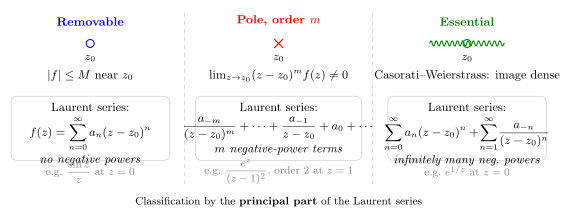
Three types of isolated singularity. Let be analytic on a punctured disc with Laurent series . The singularity at is:
- Removable if for all (no principal part). Equivalently, is bounded near .
- Pole of order if and for all (principal part has exactly terms).
- Essential if infinitely many for (principal part has infinitely many terms).
Riemann removable singularity theorem. An isolated singularity of is removable if and only if is bounded on some punctured neighbourhood of .
Liouville’s theorem. A bounded entire function is constant.
Key pattern: entire at . If is entire, then , so the singularity of at is removable if all for (i.e. is constant), a pole of order if is a polynomial of degree , and essential if is a transcendental entire function (infinitely many nonzero Taylor coefficients).
Question Archetypes
| Archetype | Recognition |
|---|---|
| singularity-classification | ”classify the singularity”, “find the principal part”, or “Laurent series of “ |
| liouville-application | ”entire such that is a removable singularity of ”; answer is that must be constant |
singularity-classification (2 question(s); 2021, 2023)
Recognition Cues — The problem asks to classify an isolated singularity (removable / pole / essential) and/or to find the principal part of the Laurent series. The function is given explicitly. If it involves where is entire, use the Taylor Laurent correspondence directly. If it is a ratio like , expand the denominator in a Maclaurin series to find the order of its zero.
Solution Template
- Find the order of the zero of the denominator (or the number of nonzero negative-power terms) at the singular point.
- Classify: zero of order in denominator pole of order ; infinitely many negative powers essential; none removable.
- To find the principal part: expand numerator and denominator as power series, invert using , multiply, and collect all terms with negative powers.
Worked Example — 2021 (abstract)
2021 Paper 2, 2021-P2-Q3a (15 marks)
Let be entire with Taylor series at having infinitely many nonzero terms. Show that is an essential singularity of .
Setup. entire means converges everywhere, with infinitely many .
Step 1 — Substitute. Let . Substituting in the Taylor series:
This is the Laurent series of centred at , valid for .
Step 2 — Classify. A singularity is essential when the principal part (negative-power terms) has infinitely many nonzero terms. Here the coefficient of is . Since infinitely many , the principal part contains infinitely many nonzero terms.
Therefore is an essential singularity of .
Example: has for all , so has essential singularity at — the textbook illustration of Picard’s theorem.
Worked Example — 2023 (explicit principal part)
2023 Paper 2, 2023-P2-Q4b (15 marks)
Classify the singular point of and obtain the principal part of its Laurent series expansion.
Step 1 — Order of the zero of at . Using :
The leading term is , so has a zero of order 3 at .
Step 2 — Classify the singularity. Since , the function has a pole of order 3 at .
Step 3 — Expand . Write so that
Retaining terms up to :
Therefore:
Step 4 — Multiply by and collect negative powers.
- Coefficient of : .
- Coefficient of : .
- Coefficient of : .
The singularity is a pole of order 3, with residue .
Common Traps
- has a zero of order 3, not order 1. The terms cancel in ; only the term survives as the leading term. Do not check and call it a simple zero.
- To get the coefficient of the full product, you must keep the term of when multiplying against . Missing this gives a wrong residue.
- The expansion requires the term to correctly evaluate the coefficient; skipping gives a wrong coefficient of (though in this problem the coefficient from alone is correct).
- Verify: , confirming order exactly 3.
liouville-application (1 question(s); 2017)
Recognition Cues — The problem says is entire and asks to characterise all such satisfying some singularity condition on . The condition “removable singularity at of ” translates to ” is bounded at infinity”, which combined with entirety and Liouville forces to be constant.
Solution Template
- Apply Riemann’s removable singularity theorem: removable bounded near bounded for .
- On the compact disc , is continuous hence bounded.
- Combine: bounded on all of .
- Invoke Liouville: bounded entire constant.
- Verify the converse: constant functions trivially satisfy the condition.
Worked Example
2017 Paper 2, 2017-P2-Q1d (10 marks)
Determine all entire functions such that is a removable singularity of .
Setup. Let , which is analytic on since is entire and is analytic for . We want to be a removable singularity of .
Step 1 — Removable bounded. By Riemann’s removable singularity theorem, is removable for if and only if is bounded on some punctured neighbourhood :
Step 2 — Translate to behaviour at . Substituting , as ranges over the variable ranges over . So the condition becomes
Step 3 — is bounded on all of . Since is entire, it is continuous on the closed disc , which is compact. Continuous functions on compact sets are bounded, so for . Combining:
Step 4 — Liouville’s theorem. A bounded entire function is constant. Therefore for some constant .
Converse. If , then is constant on the punctured plane, so is trivially a removable singularity. Every constant satisfies the condition.
Laurent verification: Write . Then . Singularity at is removable iff all for , i.e. is constant. Agrees exactly with the boxed answer.
Common Traps
- “Removable” is stronger than “isolated”. The correct criterion is boundedness (Riemann), not just that exists in some sense. Do not confuse removable with pole.
- After Step 2 you only know is bounded outside a disc. You still need the compactness argument on the closed disc before invoking Liouville.
- The Laurent series check is the fastest sanity check: removable no negative-power terms all higher Taylor coefficients of vanish is constant.
Marks-Aware Writing
For a 10-mark question (2017 type): state Riemann’s theorem, translate boundedness to , invoke compactness, invoke Liouville — four steps clearly labelled, 2–3 marks each. For a 15-mark question (2021, 2023): the 2021 proof needs explicit Laurent series setup and classification by definition; the 2023 question needs the full power-series computation with the denominator expansion shown step by step and the principal-part terms identified term by term. Writing the principal part in any form not broken into terms will lose marks.
Practice Set
- 2024-P2-Q3a (15 m) — — Hint: identify each factor’s zero order at ; note that both and vanish there, giving a pole of order 2.
- 2013-P2-Q1d (10 m) — — Hint: standard Liouville or Laurent argument for singularity type.
- 2021-P2-Q8c (20 m) — — Hint: likely involves both classification and principal part; expand denominator carefully.
- 2019-P2-Q4b (10 m) — — Hint: check whether the singularity is removable or a pole by the limit test.
- 2018-P2-Q4b (15 m) — — Hint: combine singularity classification with residue computation.