Laurent’s series in an annulus
At a Glance
- Frequency: 8 sub-parts across 8 of 14 years (2014, 2015, 2018, 2019, 2021, 2022, 2025, 2026)
- Priority tier: T2
- Marks (count): 10 (4), 15 (1), 20 (2)
- Average solve time: ~13 min
- Difficulty mix: medium 5, hard 2
- Section: A | Dominant type: computation
Why This Chapter Matters
Laurent series appears in every year from 2014 to 2025 (7 appearances) in Section A at 10–20 marks. The 20-mark questions (2015, 2021) require three separate expansions corresponding to three annuli around z=0. The 10-mark questions ask for a single annulus, typically the one nearest a specified singularity. The entire topic reduces to one skill: after partial-fraction decomposition, choose the correct geometric-series direction (in z or in 1/z) for each factor depending on which annulus you are in. Once that choice is systematic, the mechanics are routine.
Minimum Theory
Laurent series. A function analytic in an annulus r<∣z−z0∣<R has a unique Laurent expansion there:
f(z)=∑n=−∞∞cn(z−z0)n.
The terms with n<0 form the principal part; the terms with n≥0 form the analytic part.
Key tool: geometric series in two directions. For a simple factor (z−a)−1:
- If ∣z−z0∣<∣a−z0∣ (inside the singularity): factor out (a−z0) and expand in z−z0. Example about z0=0:
z−a1=−a−z1=−a1⋅1−(z/a)1=−a1∑n=0∞(az)n,∣z∣<∣a∣.
- If ∣z−z0∣>∣a−z0∣ (outside): factor out (z−z0) and expand in (a−z0)/(z−z0). Example:
z−a1=z1⋅1−(a/z)1=z1∑n=0∞(za)n=∑n=0∞zn+1an,∣z∣>∣a∣.
Coefficient formula — the tool for when partial fractions are unavailable. The Laurent expansion in a given annulus is unique, and its coefficients are contour integrals: for any positively oriented circle Cr:∣z−z0∣=r lying inside the annulus,
cn=2πi1∮Cr(w−z0)n+1f(w)dw,n∈Z.
The value does not depend on which r you choose. Two consequences carry every question where the geometric-series route is not available (because f is transcendental in z+1/z, say, and has no partial fractions at all):
- Uniqueness is a working tool, not a footnote. If two two-sided series represent the same f on the same annulus, their coefficients agree term by term. So any symmetry of f can be converted into a symmetry of the cn — see
laurent-coefficient-integral.
- Choosing r=1 makes the coefficient real. On ∣w∣=1 put w=eiθ: then dw=ieiθdθ, the eiθ cancels against one power of w−(n+1), and w+w1=2cosθ is real. A complex contour integral becomes a real Fourier-type integral over [0,2π].
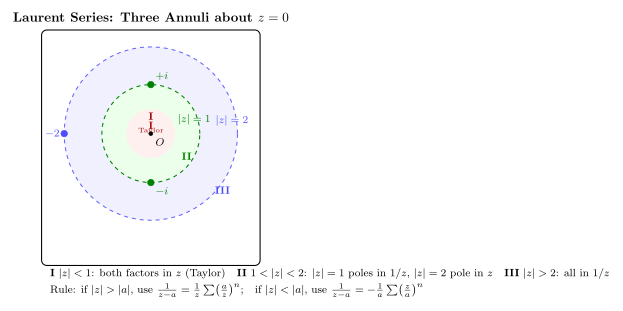
Procedure (rational f). (1) Partial-fraction decompose f. (2) Identify the singular radii: the moduli ∣aj−z0∣ for each singularity aj, listed in increasing order — these divide the plane into concentric annuli. (3) In each annulus, choose the expansion direction for each factor: inside → power series in (z−z0); outside → power series in 1/(z−z0).
Number of annuli. With k distinct singular radii, there are k+1 regions: the disc ∣z−z0∣<r1, then each annulus rj<∣z−z0∣<rj+1, then the exterior ∣z−z0∣>rk. The “about z=0” question with poles at ∣z∣=1 and ∣z∣=2 gives exactly three regions.
Question Archetypes
Two patterns, split by whether the series is computed or characterised.
| Archetype | You are seeing this when… |
|---|
| laurent-expansion | find Laurent (or Taylor) series of a rational or transcendental function in one or more specified annuli |
| laurent-coefficient-integral | the expansion is given and you must prove it, with the coefficients presented as an integral |
laurent-expansion (7 question(s); 2014, 2015, 2018, 2019, 2021, 2022, 2025)
Recognition Cues
- “Find the Laurent series of f(z) in [annulus description].”
- “Find all possible Taylor/Laurent expansions about z=z0.”
- “Expand f in the region 0<∣z−a∣<r.”
Solution Template
- Partial fractions (for rational functions). Write f=∑jAj/(z−aj)kj.
- Identify the singular radii from z0: compute ∣aj−z0∣. Sort them: r1<r2<…<rk.
- List the annuli: ∣z−z0∣<r1, r1<∣z−z0∣<r2, …, ∣z−z0∣>rk.
- In each annulus, expand each factor:
- For ∣z−z0∣<∣aj−z0∣: expand (z−aj)−1 in powers of (z−z0).
- For ∣z−z0∣>∣aj−z0∣: expand in powers of 1/(z−z0).
- Collect terms (sum the series). State the annulus of validity explicitly.
- For transcendental functions (e.g. 1/(ez−1)): factor out the lowest-power zero of the denominator, expand the remaining factor as 1/(1+w)=∑(−w)n collecting terms to the required order.
Worked Example(s)
2015 Paper 2, 2015-P2-Q2c (20 marks)
Find all Taylor/Laurent expansions of f(z)=(2z−3)/(z2−3z+2) about z=0.
Partial fractions: f=1/(z−1)+1/(z−2). Singular radii from 0: ∣1∣=1, ∣2∣=2. Three regions:
Region I (∣z∣<1): both factors inside their singularities.
z−11=−∑n=0∞zn,z−21=−21∑n=0∞(2z)n.
f(z)=−n=0∑∞(1+2n+11)zn,∣z∣<1.
Region II (1<∣z∣<2): first factor outside (∣1/z∣<1), second still inside (∣z/2∣<1).
z−11=z1∑n=0∞z−n=∑n=1∞z−n,z−21=−21∑n=0∞(z/2)n.
f(z)=n=1∑∞z−n−n=0∑∞2n+1zn,1<∣z∣<2.
Region III (∣z∣>2): both factors outside.
z−11=∑n=1∞z−n,z−21=z1∑n=0∞(2/z)n=∑n=1∞zn2n−1.
f(z)=n=1∑∞zn1+2n−1,∣z∣>2.
2014 Paper 2, 2014-P2-Q1d (10 marks)
Laurent series of 1/(z2(z−1)) about z=0 and z=1.
About z=0, region 0<∣z∣<1:
f=z21⋅z−11=−z21∑n=0∞zn.
f(z)=−z21−z1−1−z−z2−⋯,0<∣z∣<1.
About z=1, region 0<∣z−1∣<1: let w=z−1, z=1+w:
f=w(1+w)21=w1∑n=0∞(−1)n(n+1)wn=w1−2+3w−4w2+⋯
f(z)=z−11−2+3(z−1)−4(z−1)2+⋯,0<∣z−1∣<1.
2019 Paper 2, 2019-P2-Q4b (10 marks)
First three terms of the Laurent series of 1/(ez−1) in 0<∣z∣<2π.
ez−1=z(1+z/2+z2/6+⋯)=:z(1+w). So f=z1⋅1+w1=z1(1−w+w2−⋯).
1−w+w2=1−(z/2+z2/6)+z2/4+⋯=1−z/2+(1/4−1/6)z2+⋯=1−z/2+z2/12+⋯
ez−11=z1−21+12z−⋯,0<∣z∣<2π.
2018 Paper 2, 2018-P2-Q4b (15 marks)
Laurent series of 1/((1+z2)(z+2)) in (i) ∣z∣<1, (ii) 1<∣z∣<2, (iii) ∣z∣>2.
Partial fractions: f=51⋅z+21+51⋅z2+12−z. Singular radii: ∣±i∣=1, ∣−2∣=2.
(i) ∣z∣<1: both 1/(z+2) and 1/(z2+1) expand in powers of z (Taylor):
f=51∑n=0∞2n+1(−1)nzn+51(2−z)∑n=0∞(−1)nz2n.
(ii) 1<∣z∣<2: 1/(z+2) still in z; 1/(z2+1) switches to 1/z2 (since ∣z∣>1):
f=51∑n=0∞2n+1(−1)nzn+51(2−z)∑n=0∞(−1)nz−2n−2.
(iii) ∣z∣>2: both expand in 1/z:
f=51∑n=0∞(−1)n2nz−n−1+51(2−z)∑n=0∞(−1)nz−2n−2.
2025 Paper 2, 2025-P2-Q1d (10 marks)
Expand f(z)=1/((z+1)(z+3)) valid for 1<∣z∣<3.
In this annulus ∣z∣>1 (so 1/(z+1) expands in 1/z) and ∣z∣<3 (so 1/(z+3) expands in z/3):
z+11=z1⋅1+1/z1=z1∑n=0∞zn(−1)n=∑n=0∞zn+1(−1)n.
z+31=31⋅1+z/31=31∑n=0∞(−3z)n.
Partial fractions: f=21(z+11−z+31):
f(z)=21n=0∑∞zn+1(−1)n−61n=0∑∞(−3z)n,1<∣z∣<3.
Common Traps
- Choosing the wrong direction: if you use ∣z∣<∣a∣ expansion when in the ∣z∣>∣a∣ region, you get a series that diverges. Always determine which inequality holds for each factor in the given annulus.
- Forgetting the minus sign in 1/(z−a)=−1/(a−z) for the ∣z∣<∣a∣ expansion. Write the geometric-series step explicitly to avoid this.
- “About z=0” means expand in powers of z, not z−a for some other centre. If the question says “about z=1”, substitute w=z−1 before expanding.
- 1/(1+w)2 is not the same as 1/(1−w2). For repeated poles near the expansion centre, the expansion is ∑n=0∞(−1)n(n+1)wn (from differentiating the geometric series).
- Transcendental functions: factor out the zero of lowest order (ez−1=z(1+higher)), divide by z, then invert 1+w as a geometric series.
laurent-coefficient-integral (1 question(s); 2026)
This is the other kind of Laurent question, and the geometric-series machinery above is useless for it. Here the series is handed to you and the coefficients are presented as an integral; your job is to prove the representation and identify the coefficients. There is nothing to partial-fraction.
Recognition Cues
- “Prove that f(z)=a0+∑an(zn+z−n), where an=…” — the expansion is stated, not requested.
- The coefficients are printed as a real integral over [0,2π], typically with a cosnθ weight.
- The two-sided series appears in the folded form zn+z−n rather than as ∑−∞∞cnzn.
- The function is transcendental in z+z1 (or in z−z1) — a shape with no partial-fraction decomposition.
Solution Template
- Name the annulus and justify it. Locate the singularities; for f(z)=g(z+z1) with g entire the only one is z=0, so the annulus is the whole punctured plane 0<∣z∣<∞. Say why it is that annulus — the region of validity is examinable content, and it is also what licenses step 3.
- Invoke Laurent’s theorem to write f(z)=∑n=−∞∞cnzn there, quoting the coefficient formula and the uniqueness clause explicitly. You will use uniqueness as a tool, so state it.
- Fold the series using the functional symmetry. If f(1/z)=f(z) and the annulus is invariant under z↦1/z (as 0<∣z∣<∞ is), substitute 1/z into the expansion, re-index m=−n — legitimate because Laurent convergence is absolute — and compare with the original. Uniqueness forces c−n=cn, which is exactly what collapses ∑−∞∞cnzn into c0+∑n≥1cn(zn+z−n).
- Evaluate the coefficient on ∣z∣=1. Put w=eiθ in the coefficient formula. The 2πi1 and the dw=ieiθdθ combine to 2π1dθ, and w+w1=2cosθ.
- Kill the imaginary part. The result is cn=2π1∫02πf(real)e−inθdθ; split into cos and sin parts and show the sin integral vanishes — by the reflection θ↦2π−θ, not by assertion. Only then is cn=an.
Worked Example
2026 Paper 2, 2026-P2-Q3a (15 marks)
Prove that cosh(z+z1)=a0+∑n=1∞an(zn+zn1), where an=2π1∫02πcosnθcosh(2cosθ)dθ.
Source: analysis/solutions/2026-P2-Q3a.md
Step 1 — Annulus. z↦z+z1 is analytic on C∖{0} and cosh is entire, so f(z)=cosh(z+z1) is analytic on the punctured plane 0<∣z∣<∞ — itself an annulus, with r1=0 and r2=∞. (z=0 is an isolated essential singularity: coshw→∞ along real w but oscillates boundedly along imaginary w, so f has no limit there.)
Step 2 — Laurent. By Laurent’s theorem there is a unique representation f(z)=∑n=−∞∞cnzn on 0<∣z∣<∞, converging absolutely, with cn=2πi1∮∣w∣=rf(w)w−n−1dw for any r>0.
Step 3 — The folding symmetry. The argument z+z1 is unchanged by z↦z1, so
f(z1)=f(z)(z=0).
The annulus 0<∣z∣<∞ is invariant under inversion, so we may substitute and stay in the region of validity:
f(z1)=∑n=−∞∞cnz−n=∑m=−∞∞c−mzm,
the re-indexing being legitimate by absolute convergence. So ∑mc−mzm=∑mcmzm on the same annulus, and uniqueness gives
c−n=cnfor all n.
Splitting the series accordingly,
f(z)=c0+∑n=1∞cnzn+∑n=1∞c−nz−n=c0+∑n=1∞cn(zn+zn1).
The printed shape is now established; only the identification of cn remains.
Step 4 — Take r=1. With w=eiθ we get w+w1=2cosθ and dw=ieiθdθ, so
cn=2πi1∫02πei(n+1)θcosh(2cosθ)ieiθdθ=2π1∫02πcosh(2cosθ)e−inθdθ.
Step 5 — The imaginary part vanishes. Let In=∫02πcosh(2cosθ)sinnθdθ. Substituting θ=2π−ϕ and using cos(2π−ϕ)=cosϕ, sinn(2π−ϕ)=−sinnϕ gives In=−In, so In=0. Hence
cn=2π1∫02πcosnθcosh(2cosθ)dθ=an,
and each cn is real. Combining with Step 3:
cosh(z+z1)=a0+n=1∑∞an(zn+zn1),0<∣z∣<∞.■
Worth one extra line: replacing θ by θ+π in the coefficient integral (a shift by a period) and using that cosh is even gives an=(−1)nan, so an=0 for every odd n. Equivalently f(−z)=f(z), so only even powers occur. Noting this shows you are reading the object rather than reciting a method.
Common Traps
- Reaching for partial fractions. There are none. If the function is transcendental in z+z1, the geometric-series route above does not apply at all and the coefficient formula is the only way in.
- Asserting c−n=cn instead of proving it. Without it the folded form an(zn+z−n) is unearned, and that folding is a large share of the marks. Either route works — the uniqueness argument of Step 3, or the direct one-liner c−n=2π1∫cos(−nθ)cosh(2cosθ)dθ=an once Step 5 is done — but one of them must appear.
- Discarding the imaginary part by fiat. cn is a priori complex; that ∫02πcosh(2cosθ)sinnθdθ=0 needs the reflection argument. “By symmetry” without the substitution is not enough at 15 marks.
- Confusing the two normalising constants. The Laurent coefficient carries 2πi1; the final real formula carries 2π1. The i is cancelled by the i in dw — show that cancellation.
- Omitting the annulus. "0<∣z∣<∞" is not decoration here: it is the statement that 0 is the only singularity, and its invariance under z↦1/z is precisely what makes Step 3 legal.
Practice Set
- 2021-P2-Q2c (20 m) — — three-region expansion for a rational function with a cubic denominator about z=0; the hardest mark-value variant.
- 2022-P2-Q1d (10 m) — — two annuli about z=1 and z=3; uses substitution w=z−1.