Groups: definition, axioms, examples
At a Glance
- Frequency: 3 sub-parts across 3 of 14 years (2015, 2021, 2026)
- Priority tier: T3
- Marks (count): 10 (1), 5 (1)
- Average solve time: ~5 min
- Difficulty mix: easy 2
- Section: A | Dominant type: construction / proof
Why This Chapter Matters
Group questions in UPSC Section A divide cleanly into two types: constructing composition tables for order-4 groups (2015, 5 marks) and the Bézout/well-ordering argument for the GCD (2021, 10 marks). Both are self-contained and fast: the table question rewards knowing the two groups of order 4 cold, and the Bézout question has a single 4-step proof. Once you know the axioms precisely and the well-ordering trick, both archetypes are solved in under 6 minutes.
Minimum Theory
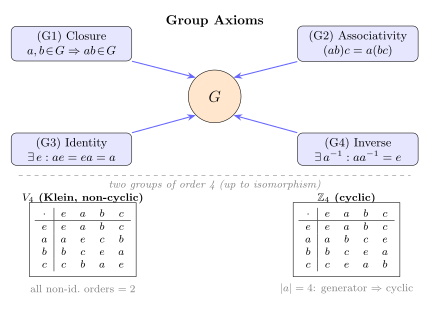
Group axioms. A group is a set with a binary operation satisfying: (G1) closure: ; (G2) associativity: ; (G3) identity: with ; (G4) inverses: with .
Order. The order of a group is its cardinality. The order of an element is the smallest with , or if none exists. A group is cyclic if some element generates all of : .
Groups of order 4. Up to isomorphism there are exactly two: the cyclic group (has an element of order 4) and the Klein four-group (every non-identity element has order 2). Any group of order 4 constructed from is isomorphic to one of these.
The dihedral group , and presentations. is the group of order with
Concretely it is , with product ; for it is the symmetry group of the regular -gon ( rotations , reflections ). Two conventions that must be stated when they are used: and (abelian — “dihedral of order 4” is the Klein group, not a polygon group). is abelian .
The working form of the relation is obtained by iterating and using :
which lets every be pushed to the right past any power of — that is what produces the normal form or and hence the bound .
Bézout / well-ordering principle. For positive integers with , the set is non-empty and has a minimum by the well-ordering of . One shows , giving integers with .
Question Archetypes
| Archetype | Recognition |
|---|---|
| construct-group-tables | ”Construct composition tables” for a group of small order; show one cyclic, one not |
| bezout-gcd | ”Show can be expressed as integer linear combination”; well-ordering proof |
| dihedral-from-involutions | generated by two elements of order 2; identify as with |
construct-group-tables (1 question(s); 2015)
Recognition Cues — asked to exhibit two distinct group structures on , one cyclic and one not; or equivalently, to write out Cayley tables for the two groups of order 4.
Solution Template
- Identify the two groups of order 4: (cyclic) and (Klein, non-cyclic).
- Write the cyclic table: powers of a generator fill each row/column.
- Write the Klein table: every non-identity element is its own inverse; product of any two distinct non-identity elements is the third.
- Verify both tables are Latin squares (each element appears exactly once per row and column).
- Show cyclicity: point to an element of order 4 (cyclic case); show all non-identity orders are 2 (Klein case, hence no generator, not cyclic).
Worked Example
2015 Paper 2, 2015-P2-Q1a-ii (5 marks)
Taking a group of order 4, where is the identity, construct composition tables showing that one is cyclic while the other is not.
Cyclic group . Relabel: , .
Element orders: , , , . Since has order 4, . Cyclic.
Klein four-group . Each non-identity element is its own inverse; product of any two distinct non-identity elements gives the third.
Element orders: , . No element generates . Not cyclic.
Common Traps
- Both tables must be Latin squares: every element appears exactly once in each row and column. Check this explicitly.
- The cyclic table is not just “fill in order”; you must show the multiplication rules , , etc.
- Proving non-cyclicity means showing no element of has order 4 — pointing to all three non-identity elements having order 2 is the correct argument.
- because the classifying invariant is the existence of an element of order 4, not the table pattern.
bezout-gcd (1 question(s); 2021)
Recognition Cues — “Show there exist integers with ”; “GCD as integer linear combination”; “well-ordering principle applied to a set of linear combinations.”
Solution Template
- Let . Show (take , rest ).
- By well-ordering, has a minimum element .
- Show for each : divide ; if then with — contradiction. So .
- Any common divisor of all divides every linear combination, so . Since divides each , . Combined with , conclude .
Worked Example
2021 Paper 2, 2021-P2-Q1a (10 marks)
Let be positive integers, . Show there exist integers with .
Step 1 — Set-up. Let . Taking , gives , so .
Step 2 — Well-ordering. By the well-ordering principle, has a minimum element .
Step 3 — divides each . Apply the division algorithm: , . Then
which is an integer linear combination of . If then with , contradicting minimality. Hence , so for all .
Step 4 — . Since is a common divisor of all , (the gcd is the largest common divisor). Conversely, for all , so divides every integer linear combination, in particular , giving . Hence .
Common Traps
- Show both and to conclude equality — just showing is a common divisor is not enough.
- The key contradiction at Step 3 requires constructing the explicit expression for as a linear combination; write it out.
- This is the general case ( integers); for , the standard Bézout identity is the special case.
dihedral-from-involutions (1 question(s); 2026)
Two involutions is the trigger. The instant a group is generated by two elements of order 2, set and : the pair satisfies the defining dihedral relations, and the question becomes a counting problem.
Recognition Cues
- ” is generated by two elements of order 2 each.”
- The conclusion names with — the order of the product, not of either generator.
- “Finite group” is given, and is doing exactly one job (see the traps).
Solution Template
- Fix a model of first, one already known to have order — otherwise the counting argument at the end is circular.
- Change generators: , . Then (since ), so .
- Verify the three relations: by definition of ; ; and, using , ,
- Normal form: show is closed under products and inverses using , contains and , hence equals . This gives .
- Prove — this is where the marks are. If then is cyclic, hence abelian, so commute and , forcing ; both and then contradict .
- Distinctness, three checks: rotations distinct (order of ); reflections distinct (cancel ); no rotation equals a reflection (else ). Hence .
- Exhibit the isomorphism , and check it respects the four product types — do not merely assert it.
Worked Example
2026 Paper 2, 2026-P2-Q2a (15 marks)
Let be a finite group generated by two elements and of order 2 each. Show that is isomorphic to the dihedral group of order , where .
Source: analysis/solutions/2026-P2-Q2a.md
Generators. Put , , (finite because is). Then , so and .
Relations. ; with ; and . Iterating, .
Normal form. With , the four products are
so is closed; gives closure under inverses. Since and and is the smallest such subgroup, and .
The key lemma. If then is cyclic, hence abelian, so and . If then , i.e. — contradicting . If then and force , i.e. , giving — contradicting . Hence .
Distinctness. with would give , impossible; cancels to ; and would put . So the listed elements are distinct and .
Isomorphism. , is well defined and bijective (it matches two lists of distinct elements term by term), and the four product identities above match the corresponding ones in case by case. Hence .
The boundary cases, worth 90 seconds. : so and . : commute and is the Klein four-group , which is abelian. For , is non-abelian and is the symmetry group of the regular -gon.
Common Traps
- Asserting . The normal form only gives ; the reverse needs plus the three distinctness checks. Skipping this drops 4–5 marks.
- Writing ” is non-abelian, being dihedral”. False at . The statement is true as printed for every only under the conventions , .
- Assuming . The question does not say it; gives and must not break the proof.
- Exhibiting a bijection and stopping. An isomorphism must be checked to respect the operation — the four product types are the check.
- Misreading which order is . It is , not or (both are 2). Harmlessly, , since is conjugate to .
- “Finite” is not decorative but it is small. It is used exactly once, to make finite. Since , the hypothesis is equivalent to ” has finite order”; dropping it gives the infinite dihedral group , not a counterexample.
Marks-Aware Writing
For the 5-mark table question: two complete, correct Cayley tables earn 3 marks; identifying orders and naming which is cyclic earns the remaining 2. Do not just draw a table without verifying the Latin square property (each element once per row/column).
For the 10-mark Bézout proof: a complete proof needs (a) non-emptiness of , (b) well-ordering cited by name, (c) the division-algorithm step producing the contradiction, and (d) the two-sided argument and . Any one of these missing costs 2–3 marks. Citing well-ordering without writing “By the well-ordering principle of ” is acceptable but explicit citation is safer.
Practice Set
- 2014-P2-Q1a (10 m) — — Hint: show is a group by verifying all four axioms directly, then check normality by explicit conjugation .