Line integrals
At a Glance
- Frequency: 8 sub-parts across 8 of 14 years (2015, 2017, 2018, 2019, 2020, 2021, 2022, 2025)
- Priority tier: T1
- Marks (count): 12 (1), 13 (1), 15 (5), 8 (1)
- Average solve time: ~10 min
- Difficulty mix: easy 4, medium 4
- Section: B | Dominant type: computation
Why This Chapter Matters
Line integrals appear in 8 of the last 14 years, mostly as 15-mark questions. Green’s theorem — the 2D version of Stokes — converts a closed loop integral into a double integral over the enclosed region and back. Five of the eight questions use Green’s theorem directly (three evaluation, two verification). The remaining three cover the vortex field, path-dependence, and a direct circulation. Every question has a well-defined method; the only judgement call is whether to apply Green’s or parametrise directly.
Minimum Theory
Line integral. For a vector field and curve : Parametrise : substitute , , , integrate over .
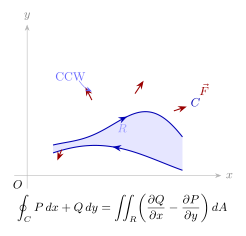
Green’s theorem. For a closed, counterclockwise-oriented curve bounding a region : The double integral is the flux of the “curl” ( component of ) through the region.
Conservative fields. is conservative iff everywhere on a simply connected domain. Then for every closed , and the integral between two points is path-independent.
The vortex field. satisfies everywhere except the origin. For a closed : integral if doesn’t enclose origin; if winds times around origin. This is a topological (winding number) result.
Question Archetypes
Five patterns cover all line integral questions.
| Archetype | You are seeing this when… |
|---|---|
| greens-theorem | evaluate using the double-integral side of Green’s theorem |
| greens-verification | ”verify Green’s theorem” — compute both sides |
| circulation | evaluate by direct parametrisation of each arc |
| contour-singularity | field is or similar — winding number argument |
| path-dependence | compute integral along multiple paths; explain why results differ |
greens-theorem (3 question(s); 2015, 2017, 2018)
Recognition Cues
- “Using Green’s theorem, evaluate ” or “evaluate .”
- The closed curve bounds a simple region (rectangle, parabola-line, two parabolas).
Solution Template
- Identify and ; compute .
- Describe the region (find intersection points; state which curve is upper/lower).
- Set up and evaluate .
- Check orientation: CCW gives the positive sign in Green’s theorem.
Worked Example(s)
2015 Paper 1, 2015-P1-Q8c (12 marks)
Evaluate around rectangle with vertices .
, . .
2017 Paper 1, 2017-P1-Q8c-ii (8 marks)
Green’s theorem for around , CCW.
. Region: (from ), from to .
The term is odd in and integrates to zero over :
2018 Paper 1, 2018-P1-Q8c (13 marks)
Integrate for over first-quadrant region to , using Green’s.
. Region: , from to .
Common Traps
- Orientation. CCW is the standard (positive) sign. Verify the vertex listing before concluding CCW.
- Sign of : both and may have the same sign. Here and — they don’t cancel; they add.
- For the 2018 curl problem: Green’s theorem says ; the double integral IS what’s asked, so no boundary integral needed.
- In the parabola-line region (2017): odd-function terms in vanish over by symmetry — state this explicitly.
greens-verification (2 question(s); 2022, 2025)
Recognition Cues
- “Verify Green’s theorem” — must compute both the line integral and the double integral independently and confirm they agree.
- Region is a triangle or the area between two parabolas/curves.
Solution Template
- Double integral side. Compute ; integrate over .
- Line integral side. Orient the boundary CCW. Parametrise each segment/arc; evaluate each contribution; sum.
- State equality.
Worked Example(s)
2022 Paper 1, 2022-P1-Q6c (15 marks)
Verify Green’s for over triangle , , .
Double integral. : .
Line integral (CCW: ):
- Side 1 (): .
- Side 2 (): .
- Side 3 (): .
Sum . Both sides equal . ✓
2025 Paper 1, 2025-P1-Q7b (15 marks)
Verify Green’s for over region bounded by and .
Double integral. : .
Line integral (CCW: parabola then line ):
- (): .
- (, reversed): .
Sum . Both sides . ✓
Common Traps
- CCW orientation on the triangle: — going right then diagonally back is CCW ✓.
- Parametrising Side 2 of the triangle: , ; the minus sign propagates into the integrand.
- For the 2025 two-curve region: the parabola is the lower boundary (traversed left-to-right), the line is the upper boundary (traversed right-to-left for CCW orientation).
- Always state “Green’s theorem verified” and quote the common value.
circulation (1 question; 2019)
Recognition Cues
- “Find the circulation of round the curve ” — a closed loop, direct integration required (not Green’s, or Green’s as a check).
- Two arcs meeting at two points; best to parametrise each arc separately.
Worked Example(s)
2019 Paper 1, 2019-P1-Q6b (15 marks)
; circulation round : from to , then back to .
Arc (, , ):
Arc (, , ):
Cross-check via Green’s: ; ✓.
Common Traps
- Arc : the natural parameter is (since ), running from to (reversed). Keep the reversed limits; don’t re-orient.
- The closed loop here is clockwise (out along , back along ). For the Green’s cross-check, the area integral also gives (matching; no extra sign needed since the parametric calculation already incorporates orientation).
- (not ): , .
contour-singularity (1 question; 2021)
Recognition Cues
- or — the “vortex” field.
- Closed curve, possibly enclosing the origin.
- The answer depends only on whether the origin is enclosed.
Worked Example(s)
2021 Paper 1, 2021-P1-Q6c (15 marks)
Evaluate for arbitrary closed .
, . Check: everywhere except origin.
If does not enclose origin: Green’s theorem applies; , so .
If encloses origin: Deform to a small circle (both give the same integral since between them). On : , ; .
Common Traps
- The field is locally curl-free (closed 1-form) but not globally conservative — the potential is multi-valued. This is the key distinction from ordinary conservative fields.
- The deformation argument: since between and , the integrals over them are equal (by Green’s applied to the annular region).
- On the small circle the integrand simplifies to — the factors cancel exactly.
path-dependence (1 question; 2020)
Recognition Cues
- “Compute along [multiple paths]; is the result the same? Explain.”
- If the results differ: state , hence not conservative.
Worked Example(s)
2020 Paper 1, 2020-P1-Q6b (15 marks)
. Compute from to along three paths.
Path (i) : .
Path (ii) Three straight edges: segment 1 gives ; segment 2 gives ; segment 3 gives . Total: .
Path (iii) Straight line : .
Results: , , — all different.
Why: . Since the field is not conservative, the integral is path-dependent.
Common Traps
- On polygonal path (ii): only the moving coordinate has a nonzero differential on each segment; zero out the other two.
- State the explanation in terms of — it’s required for full marks.
- Arithmetic: keep fractions exact (, , ).
Marks-Aware Writing
8-mark questions (2017): Green’s theorem in three lines — compute , set up the area integral, evaluate. No need for a preamble beyond “by Green’s theorem.”
12-13-mark questions (2015, 2018): State Green’s theorem (one line); compute ; describe the region; evaluate the double integral. Show all steps including the separability or inner integral.
15-mark questions (2019, 2020, 2021, 2022, 2025): For Green’s evaluation: full working as above. For verification (2022, 2025): state the theorem, compute both sides in clearly labelled subsections, conclude. For circulation (2019): parametrize each arc, show the integrand explicitly, sum. For path-dependence: compute all three paths, then compute the curl and state it’s nonzero.
Practice Set
| Year | Paper/Q | Marks | Archetype | One-line hint |
|---|---|---|---|---|
| 2025 | P1-Q7b | 15 | greens-verification | ; double integral ; line: gives , gives |
| 2022 | P1-Q6c | 15 | greens-verification | ; double integral ; three sides sum to |
| 2021 | P1-Q6c | 15 | contour-singularity | ; if origin not enclosed; if enclosed |
| 2020 | P1-Q6b | 15 | path-dependence | Three results differ; |
| 2019 | P1-Q6b | 15 | circulation | Parametrize arcs; , ; total |
| 2018 | P1-Q8c | 13 | greens-theorem | ; region ; inner integral ; result |
| 2017 | P1-Q8c-ii | 8 | greens-theorem | ; odd vanishes; even part ; result |
| 2015 | P1-Q8c | 12 | greens-theorem | Separable: ; result |