Frequency: 6 sub-parts across 5 of 14 years (2015, 2016, 2022, 2023, 2026)
Priority tier: T3
Marks (count): 10 (5)
Average solve time: ~6 min
Difficulty mix: easy 5
Section: B | Dominant type: computation
Why This Chapter Matters
Linear first-order ODEs appear in Section B compulsory question Q5 in most years — always for 10 marks, always easy. The integrating-factor technique is a single five-step algorithm that works identically on every question: rearrange, read off P and Q, compute μ=e∫Pdx, multiply through, integrate. The only variety is how the RHS simplifies after multiplying by μ — each question is designed to collapse to something integrable by inspection. Master one template, collect 10 free marks.
Minimum Theory
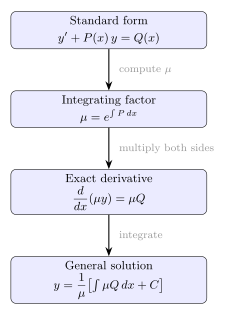
Standard form. A linear first-order ODE has the form
dxdy+P(x)y=Q(x).
If the equation is not in this form, divide by the coefficient of dy/dx first.
Integrating factor. Compute
μ(x)=exp∫P(x)dx.
Multiplying both sides by μ converts the left side to an exact derivative:
dxd(μy)=μQ.
General solution. Integrate both sides and divide by μ:
y=μ1[∫μQdx+C].
Question Archetypes
Archetype
Recognition
linear-first-order
A first-order ODE linear in y; asked to “solve” or given an initial condition
linear-solution-form
”Show the general solution can be written as [formula]” — a derivation via integration by parts
Solve a linear first-order ODE via an integrating factor
Recognition Cues
The equation contains y and dy/dx to the first power only, with no y2 or product y⋅dy/dx.
It may not look linear at first — watch for a symmetric form Mdx+Ndy=0 where treating y as the dependent variable yields a linear equation.
A 10-mark Section B question asking you to “solve” a first-order ODE, with no hint of exactness, Bernoulli, or Clairaut form, is almost certainly this archetype.
Solution Template
Rearrange to standard form: divide by the coefficient of dy/dx to get y′+P(x)y=Q(x).
Compute the integrating factor:μ=e∫Pdx (no constant of integration needed).
Multiply through: the LHS becomes dxd(μy).
Integrate the RHS:μy=∫μQdx+C.
Divide by μ to get y explicitly; apply any initial condition to find C.
Worked Example 1
2015 Paper 1, 2015-P1-Q5a (10 marks)
Solve xcosxdxdy+y(xsinx+cosx)=1.
Step 1 — Standard form. Divide by xcosx:
dxdy+(tanx+x1)y=xsecx.
So P=tanx+1/x and Q=secx/x.
Step 3 — Multiply and integrate. The RHS collapses exactly:
dxd(xcosxy)=xcosx1⋅xcosx=1.
Integrate:
xcosxy=x+C.
Step 4 — Solve for y.y=xcosx(x+C).
Worked Example 4
2023 Paper 1, 2023-P1-Q5a (10 marks)
Solve dxdy−2xy=2, y(0)=1, in the form y=ex2[1+πerf(x)].
Step 1 — Standard form. Already in standard form: P=−2x, Q=2.
Step 2 — Integrating factor.μ=e∫(−2x)dx=e−x2.
Step 3 — Multiply and integrate.dxd(e−x2y)=2e−x2.
Recall erf(x)=π2∫0xe−t2dt, so ∫2e−x2dx=πerf(x)+const:
e−x2y=πerf(x)+C.
Step 4 — Apply initial condition. At x=0: 1=0+C, so C=1.
y=ex2[1+πerf(x)].
Common Traps
Failing to rearrange first. In the 2016(Q5c) and 2016(Q6a) problems the ODE is not in standard form — there is a +y/(1+x2) hiding on the right, or a −xdy in a symmetric form. Moving y-terms to the left before reading off P and Q is essential.
Dropping the factor of 21. In 2016(Q5c), integrating e2arctanx/(1+x2) yields 21e2arctanx. The factor 21 is easy to miss when the substitution is done mentally.
Sign in ∫tanxdx. The integral is −ln∣cosx∣ (not +ln∣cosx∣). A sign error here flips the integrating factor entirely: e−ln(xcosx)=1/(xcosx), not xcosx.
erf normalisation.∫e−x2dx=2πerf(x), so ∫2e−x2dx=πerf(x). Writing ∫2e−x2dx=erf(x) drops the π factor and breaks the initial condition.
linear-solution-form (1 question(s); 2022)
Derive/prove a closed form for the general solution of y′+Py=Q
Recognition Cues
The question says “Show that the general solution of y′+Py=Q can be written as [formula].”
The given formula involves Q/P as a leading term — it looks structurally different from the standard IF solution but is algebraically equivalent.
This is a derivation question, not a computation question: start from the standard method and reach the target via integration by parts.
Solution Template
Write the standard IF solution: μy=∫μQdx+C0.
Write Q=P⋅(Q/P) inside the integral; recognise e∫Pdx⋅Pdx=d(e∫Pdx).
Integrate by parts: ∫(Q/P)d(μ)=(Q/P)μ−∫μd(Q/P).
Assemble, divide by μ, and rename C=−C0 to match the target sign.
Worked Example
2022 Paper 1, 2022-P1-Q5a (10 marks)
Show that the general solution of y′+Py=Q can be written as
y=PQ−e−∫Pdx{C+∫e∫Pdxd(PQ)}.
Step 1 — Standard solution. The integrating-factor method gives
μy=∫μQdx+C0,μ=e∫Pdx.
Step 2 — Rewrite the integral. Inside the integral write Q=P⋅(Q/P). Since d(μ)=Pμdx:
∫μQdx=∫PQd(μ).
Step 3 — Integrate by parts. With u=Q/P and dv=d(μ):
∫PQd(μ)=PQ⋅μ−∫μd(PQ).
Step 4 — Assemble. Substituting back:
μy=PQ⋅μ−∫μd(PQ)+C0.
Divide by μ and set C=−C0:
y=PQ−e−∫Pdx{C+∫e∫Pdxd(PQ)}.■
Common Traps
The key rewrite. Writing Q=P⋅(Q/P) inside the integral is the non-obvious step that makes integration by parts work. Without it, there is no natural u and dv.
Relabelling the constant. The standard solution has +C0; after the manipulation the constant flips sign, giving C=−C0. Failing to rename produces the wrong sign inside the braces.
Marks-Aware Writing
For a 10-mark computation question: Write all five steps explicitly — standard form (with division shown), integrating factor (with the integral written out), the d(μy)/dx step, integration of the RHS, and the final y. A correct final answer with two steps missing earns at most 5 marks. Label each step clearly.
For the 2022 proof question: Structure the derivation in numbered steps. The integration-by-parts step must display u, dv, and the result explicitly — “integrate by parts and simplify” earns no marks. Conclude with ■ and box the target expression.
Practice Set
2024-P1-Q5a (10 m) — — Hint: this is an orthogonal-trajectories question; the elimination step produces a linear ODE in u=r2 or similar, solvable by IF.
2020-P1-Q5b (10 m) — — Hint: after eliminating the family parameter, the ODE for the orthogonal trajectories is linear in x2+y2.
Ready to drill what you just read?
Daily Practice turns these patterns into one adaptive set a day —
practised daily until they're automatic, free for everyone.