Frequency: 3 sub-parts across 3 of 14 years (2014, 2019, 2023)
Priority tier: T3
Marks (count): 10 (1), 15 (1), 20 (1)
Average solve time: ~14 min
Difficulty mix: medium 3
Section: A | Dominant type: computation
Why This Chapter Matters
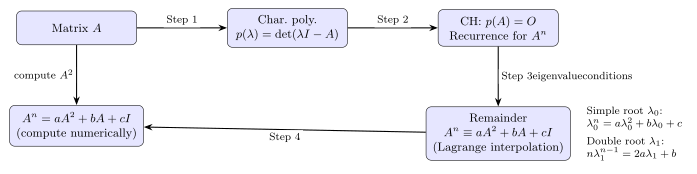
Cayley-Hamilton delivers 10–20 marks across three different question styles: compute a high matrix power, find the inverse via the characteristic equation, or evaluate a matrix polynomial by polynomial division. All three reduce to the same workflow — compute the characteristic polynomial, apply Cayley-Hamilton to reduce powers, then evaluate numerically. The 3×3 matrix with repeated eigenvalue (appearing in both 2019 and 2023) adds one step: the double-root derivative condition. A student who has practised this template can solve any variant in under 15 minutes.
Minimum Theory
Cayley-Hamilton theorem. Every n×n matrix A satisfies its own characteristic equation: if p(λ)=det(λI−A) then p(A)=O. This means every matrix power Ak (for k≥n) can be expressed as a polynomial in A of degree ≤n−1.
Power reduction via Lagrange interpolation. To find AN for large N, write λN=q(λ)p(λ)+r(λ) where degr<n. Since p(A)=O, AN=r(A). Determine the n coefficients of r by substituting each eigenvalue (with multiplicity): a simple root λ0 gives λ0N=r(λ0); a double root λ1 gives both λ1N=r(λ1) and Nλ1N−1=r′(λ1) (differentiate both sides of λN=q(λ)p(λ)+r(λ) and use p(λ1)=p′(λ1)=0).
Inverse via Cayley-Hamilton. For 2×2: from A2−(trA)A+(detA)I=O, rearrange to isolate I on one side and factor out A: A−1=((trA)I−A)/detA.
From CH: A3=A2+A−I, i.e.\ A3−A=A2−I, i.e.\ A3−A1=A2−I.
Claim:An−An−2=A2−I for all n≥3.
Proof by induction. Base n=3: A3−A=A2−I follows directly from CH. Inductive step: assume Ak−Ak−2=A2−I. Multiply both sides on the left by A: Ak+1−Ak−1=A3−A=A2−I (using the base case again). This proves Ak+1−Ak−1=A2−I.
Telescope to A40: sum the identity An−An−2=A2−I for n=4,6,8,…,40 (19 terms, all even steps):
A40−A2=19(A2−I)⇒A40=20A2−19I.
A40=20111010001−19I=12020010001.
A40=12020010001.
Common Traps
The double root λ=1 gives two conditions — value and derivative. A student who only substitutes λ=1 once has one equation too few and cannot determine all three unknowns.
Evaluate (−1)100=+1 (not −1). An even-power sign error corrupts a and c.
Always reduce to a remainder of degree ≤n−1 (here ≤2, i.e.\ aA2+bA+cI), not degree ≤n.
Triple-check A2 entry-by-entry. A single error in A2 propagates to the final answer.
For the telescope in 2023: there are exactly 19 even steps from n=4 to n=40 (i.e.\ A40−A2, with each step contributing A2−I), giving coefficient 19, not 20. The final result is A40=20A2−19I, not 21A2−20I.
cayley-hamilton-application (1 question(s); 2014)
Recognition Cues
“Verify CH; find A−1; evaluate the polynomial expression p(A).”
2×2 matrix; characteristic polynomial is quadratic λ2−(trA)λ+detA.
Inverse: factor the CH equation; polynomial evaluation: reduce all powers via the recurrence A2=(trA)A−(detA)I.
Solution Template
Characteristic polynomial.p(λ)=λ2−(trA)λ+detA.
Verify CH. Compute A2 directly and check A2−(trA)A+(detA)I=O.
Inverse. Rearrange CH: A(A−(trA)I)=−(detA)I, so A−1=((trA)I−A)/detA.
Higher powers. Use A2=(trA)A−(detA)I as the recurrence; compute A3,A4,A5,… iteratively as αkA+βkI.
Sum the polynomial. Collect all A-coefficients and all I-coefficients. Write the result as a single matrix.
Worked Example
2014 Paper 1, 2014-P1-Q2b-ii (10 marks)
Verify CH for A=(1243); find A−1; evaluate A5−4A4−7A3+11A2−A−10I.
Step 1 — Characteristic polynomial.trA=4, detA=3−8=−5. So p(λ)=λ2−4λ−5.
(Alternative: polynomial division of λ5−4λ4−7λ3+11λ2−λ−10 by λ2−4λ−5 gives remainder λ+5, so p(A)=A+5I.)
Common Traps
From A2−4A−5I=O: factor as A(A−4I)=5I (not A2−4A=5I then “solve”); the factored form directly gives A−1.
For the 2×2 case: the characteristic polynomial uses +detA (not −detA); be careful with the sign, especially when detA is negative.
When building the table in Step 5, keep separate A-coefficient and I-coefficient columns to avoid sign errors.
Marks-Aware Writing
10-mark question (2014): Verification (Steps 1–2), inverse (Step 3), and polynomial evaluation (Steps 4–5) each carry roughly 3+3+4 marks. An answer that verifies CH but miscomputes the inverse loses 3 marks; missing the polynomial evaluation entirely loses 4.
15-mark question (2019): Stating CH (2 marks), characteristic polynomial (3 marks), setting up and solving the a,b,c system (5 marks including the double-root derivative condition), computing A2 and the final matrix (5 marks).
20-mark question (2023): Verification (10 marks) and recurrence + A40 (10 marks). For verification: A2 and A3 computed correctly (5 marks), substitution and confirmation of zero (5 marks). For part (ii): proving the recurrence by induction (5 marks), telescoping correctly to get A40=20A2−19I (3 marks), final matrix (2 marks).
Practice Set
(No additional practice items beyond the three worked examples.)
Ready to drill what you just read?
Daily Practice turns these patterns into one adaptive set a day —
practised daily until they're automatic, free for everyone.