Frequency: 4 sub-parts across 4 of 14 years (2015, 2018, 2020, 2022)
Priority tier: T3
Marks (count): 10 (4)
Average solve time: ~6 min
Difficulty mix: easy 2, medium 2
Section: A | Dominant type: computation
Why This Chapter Matters
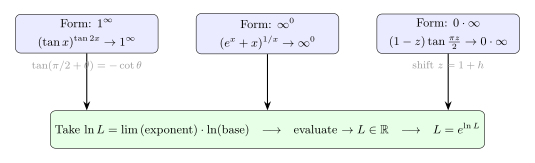
Indeterminate-form limits appear in Section A compulsory (Q1), always for 10 marks. All four historical examples involve exponential forms (1∞, ∞0) or a product (0⋅∞). The technique is always the same: take logarithm to convert the exponent to a product, then evaluate the resulting 0⋅∞ limit by substitution or L’Hôpital. The answers are always clean numbers like e2/π, e−1, or e.
Minimum Theory
The indeterminate forms that appear on UPSC:
Form
Example
Strategy
1∞
(tanx)tan2x as x→π/4
Take lnL=lim(exponent)⋅ln(base)
∞0
(ex+x)1/x as x→∞
Take lnL=limexponent−1ln(base)
0⋅∞
(1−z)tan2πz as z→1
Rewrite as 1/∞0 or substitute z=1+h
Toolkit. After taking logarithm, the limit reduces to evaluating something of the form limf(h)/g(h) as h→0, where both f and g vanish. Two methods work:
Substitution and asymptotics: replace ln(1+u)≈u, sinθ≈θ, cotθ≈1/θ for small arguments.
L’Hôpital: differentiate numerator and denominator separately; faster when the structure is simple.
Key identity.tan(2π+θ)=−cotθ. This converts tan(π/2+ε) (which blows up) into −cotε (which has a finite small-ε expansion). It appears in three of the four historical problems.
Question Archetypes
Archetype
Recognition
indeterminate-form-limit
Evaluate a limit of the form 1∞, ∞0, or 0⋅∞; answer via logarithm + substitution
Step 4. Using sin(πh/2)≈πh/2: product ≈πh/2h⋅1=π2.
Step 5. The two-sided limit exists: L=2/π.
Worked Example 4
2022 Paper 1, 2022-P1-Q1c (10 marks)
Evaluate limx→∞(ex+x)1/x.
Step 1. At x→∞: base →∞, exponent →0. Form: ∞0.
Step 2.lnL=limx→∞xln(ex+x).
Step 3. Factor ex: ln(ex+x)=x+ln(1+xe−x).
Step 4. As x→∞, xe−x→0, so ln(1+xe−x)→0. Thus lnL=1.
Step 5.L=e.
Common Traps
1∞ is NOT equal to 1. Direct substitution says ”1 raised to infinity is 1” — but this is an indeterminate form. You must take the logarithm.
The crucial identity tan(π/2+θ)=−cotθ. All three 1∞/0⋅∞ examples near π/2 use this. Forgetting the minus sign flips lnL and gives e+2/π or e+1 instead of the correct answer.
Two-sided limit in the 2018 problem. As h→0 from either side, the product hcot(πh/2)→2/π, so the two-sided limit exists. State this explicitly.
Dominant term in ∞0. For (ex+x)1/x, factor out ex immediately — x/ex→0 so the correction term vanishes. The answer is e (not e1+0; the +ln(1+xe−x)/x correction is zero).
Marks-Aware Writing
All four questions are 10 marks. Show: (a) the indeterminate form identified, (b) the logarithm step lnL=…, (c) the substitution or asymptotics, (d) the limiting value of lnL, (e) the final answer L=e(…). Each step earns 2 marks. Writing “by L’Hôpital the answer is…” without showing the differentiation earns 2–3 marks at most.
Practice Set
2023-P1-Q1c (10 m) — — Hint: this is a Taylor-coefficient matching question (Taylor expansion of cosx and sinx in the numerator), not a direct indeterminate form.
Ready to drill what you just read?
Daily Practice turns these patterns into one adaptive set a day —
practised daily until they're automatic, free for everyone.