Improper integrals (unbounded interval/integrand)
At a Glance
- Frequency: 5 sub-parts across 4 of 14 years (2017, 2019, 2022, 2023)
- Priority tier: T3
- Marks (count): 10 (4), 15 (1)
- Average solve time: ~8 min
- Difficulty mix: easy 3, medium 2
- Section: A | Dominant type: computation
Why This Chapter Matters
Improper integrals appear in Section A (Q1 compulsory) in most years, always for 10 marks. The easy questions — convergence/divergence of a given integral — are solved by a two-step algorithm: locate the singularity, compare the integrand to a standard integrable or non-integrable type ( or ). The harder question (2019) requires Feynman’s differentiation-under-the-integral-sign technique, which is a high-value skill worth learning. Mastering these two tools gives you coverage of every historical variant.
Minimum Theory
When is an integral improper? A definite integral is improper if (a) has a singularity inside or at an endpoint, or (b) the interval is unbounded. Always locate and list every singularity before proceeding.
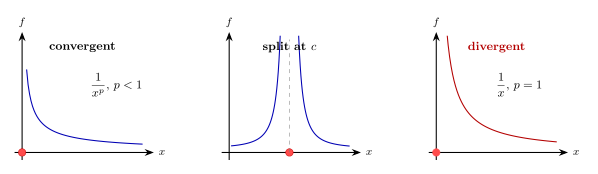
Splitting. If there are multiple singularities, split the integral so that each piece has exactly one singularity at an endpoint. The integral converges only if every piece converges.
Comparison tests. Near a singularity at : For an endpoint at where (limit comparison), the convergence/divergence of matches the power-function integral. Key standard facts:
Interior singularity. If the singularity is at an interior point , split: . Both pieces must converge.
Differentiation under the integral sign (Feynman). For an integral depending on a parameter , differentiating gives (when dominated convergence applies). Solve the resulting simpler integral, then integrate back in using a known boundary condition (usually for some evident ).
Question Archetypes
| Archetype | Recognition |
|---|---|
| convergence-test | ”Examine the convergence of ” — locate singularity, compare, conclude |
| parameter-differentiation | ”Evaluate ” with a parameter — use Feynman differentiation |
convergence-test (4 question(s); 2017, 2022, 2023)
Examine convergence/divergence by locating the singularity and applying a comparison test
Recognition Cues
- The question says “Examine the convergence of ” or “Show the integral exists.”
- The integrand blows up at one or more points in the domain of integration, or the domain is infinite.
- No numerical value is requested — only convergence/divergence.
Solution Template
- Locate all singularities: find where the integrand or where the interval is unbounded.
- Split the integral so each piece has exactly one singularity at a single endpoint.
- For each piece: compare the integrand near the singularity to a standard type. Write the limit: where (or , etc.).
- Conclude by the limit comparison test: if and converges (resp. diverges), then converges (resp. diverges).
- State the conclusion for each piece and hence for the whole integral.
Worked Example 1
2022 Paper 1, 2022-P1-Q1d (10 marks)
Examine convergence of .
Step 1 — Locate singularities. at and . Both endpoints are singular.
Step 2 — Split. .
Step 3 — Near . The integrand as . Limit comparison with : Since diverges (, borderline), diverges.
Conclusion. Since the first piece diverges, diverges.
Worked Example 2
2023 Paper 1, 2023-P1-Q1d (10 marks)
Examine convergence of .
Step 1 — Locate singularities. At : . At : , integrand is — no singularity.
Step 2 — Near . For , is continuous and bounded between and . So the integrand behaves like up to a bounded factor. The key standard fact: More precisely, for (since ), so by direct comparison with the convergent , the integral converges.
Conclusion. converges.
(The value is , obtained by expanding and using .)
Worked Example 3
2017 Paper 1, 2017-P1-Q4c (10 marks)
Examine if exists.
Step 1 — Locate singularity. at , which is interior to . Note is the real cube root, well-defined for all .
Step 2 — Split at . .
Step 3 — Singularity order near . As , , so Since , the integral of near converges. Both pieces converge.
Step 4 — Evaluate. Antiderivative: let , : (Use the real cube root throughout.)
Common Traps
- Interior singularity must be split. At , the integrand has a singularity interior to . Treating it as a regular Riemann integral and applying the antiderivative across gives the wrong answer (the change there is non-trivial) and misses the convergence question entirely.
- Real cube root, not complex principal root. For , , and using the real cube root. Using a complex root gives imaginary values.
- is borderline divergent. The integrals and both diverge; the comparison test requires for convergence at a finite endpoint.
- near zero is integrable. Since , the singularity of at is weaker than any power with . Treating as “clearly divergent” at is wrong.
parameter-differentiation (1 question(s); 2019)
Evaluate an improper integral depending on a parameter by differentiating under the integral sign
Recognition Cues
- The integral has a parameter and an unbounded domain ( to ).
- The integrand involves or a similar function where differentiation in simplifies the integrand.
- Direct integration is impossible; the answer should be a closed-form function of (like ).
Solution Template
- Define and note the boundary value (or another evident value).
- Differentiate: .
- Evaluate using partial fractions, standard integrals (, etc.).
- Integrate from to using to recover .
Worked Example
2019 Paper 2, 2019-P2-Q1c (10 marks)
Evaluate , , .
Step 1. .
Step 2 — Differentiate. , so
Step 3 — Partial fractions ():
Using and (substitute ):
(The factor cancels, so is smooth and valid for all including .)
Step 4 — Integrate back.
Common Traps
- Anchor at , not . The most natural anchor is since . Anchoring at requires knowing independently.
- Factor of in . Substituting gives . Forgetting the is a common slip.
- Split requires , but the result holds at . The partial fractions breakdown fails at , but the resulting is continuous across by L’Hôpital or direct calculation. The final formula is valid for all .
Marks-Aware Writing
For a 10-mark convergence question: the examiner marks (a) identifying the singularity/singularities, (b) the splitting step (for interior singularities), (c) the limit comparison or direct comparison argument (written explicitly with the standard integral named), and (d) the conclusion. Saying “the integrand blows up, so it diverges” with no comparison earns 2–3 marks at most.
For the Feynman technique (2019): write down with the differentiation step shown, then the partial fractions (displayed), then integrate back. The boundary condition must be stated and used explicitly.
Practice Set
- 2019-P2-Q4c (15 m) — — Hint: singularity at where ; gives a strength, borderline divergent; use limit comparison.
- 2024-P2-Q1c (10 m) — — Hint: two endpoint singularities; check each separately; both turn out to be integrable.